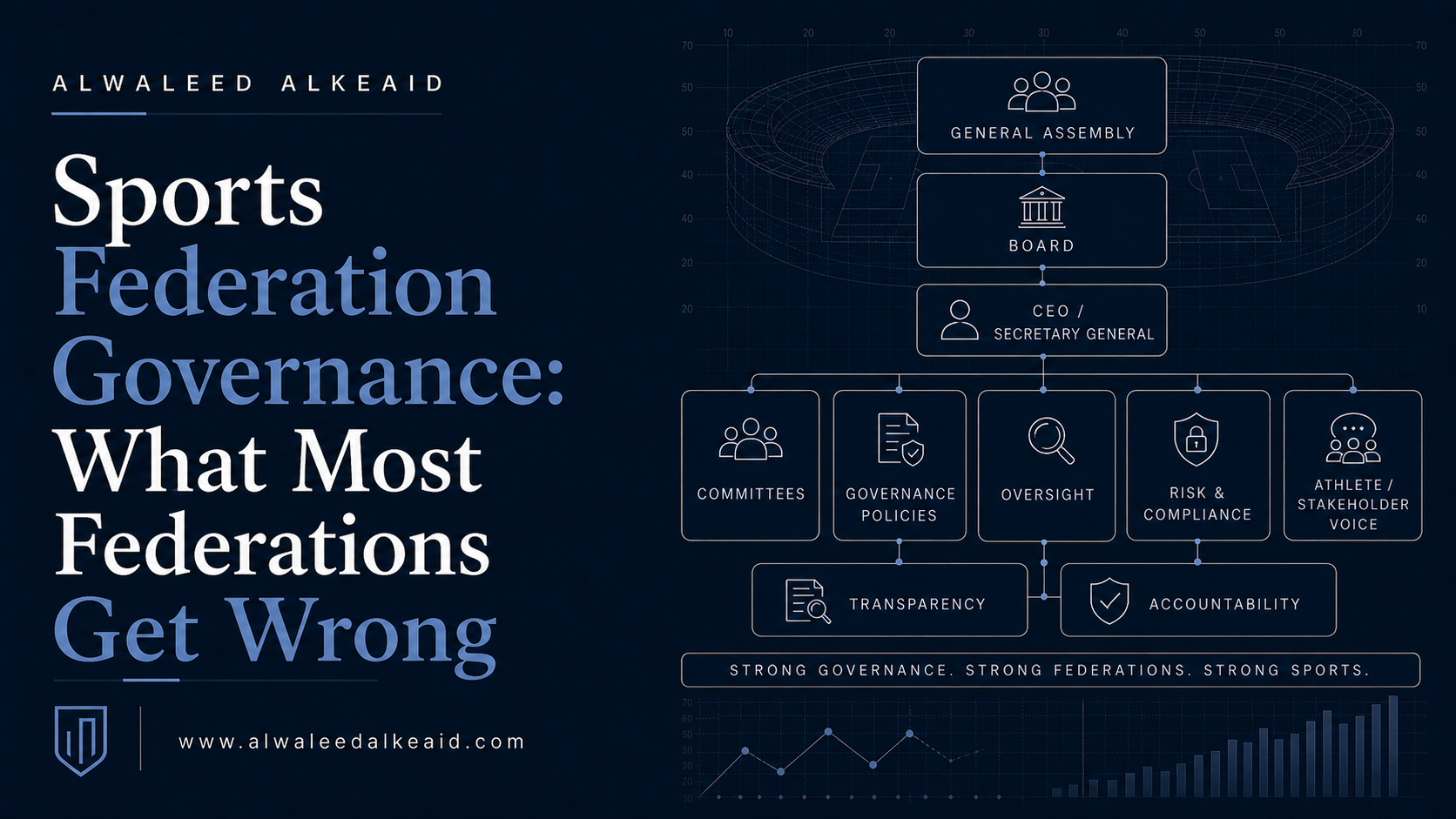
Sports federation governance is one of the biggest reasons a federation either becomes a credible institution or remains dependent on personalities, politics, and short-term decisions.
Most sports federations do not fail because they lack passion.
They fail because the system around that passion is weak.
A federation may have committed board members, ambitious executives, talented athletes, and strong national support. Yet when sports federation governance is unclear, the organization eventually struggles with slow decisions, weak accountability, role confusion, financial risk, stakeholder tension, and inconsistent performance.
That is the real governance problem in sport.
Many federations treat governance as a compliance requirement. They have a constitution. Committees exist. Meetings take place. Reports appear when someone asks for them.
On paper, everything may look organized.
In practice, the federation may still be unclear about who decides, who executes, who monitors, who reports, and who takes responsibility when results do not happen.
Good governance is not decoration.
It is the operating system of a sports federation.
The International Olympic Committee’s Basic Universal Principles of Good Governance highlight areas such as vision, mission, strategy, democratic processes, competence, ethics, accountability, transparency, control, athlete involvement, and balanced relations with governments while protecting sport autonomy.
These principles are not theoretical. They shape trust, funding, athlete protection, sponsorship, performance, and long-term credibility.
From my experience in federation leadership, sports advisory, recruitment, and governance work, the biggest issue is rarely that people do not care.
Most people in sport care deeply.
The real issue is that too many federations depend on goodwill instead of systems.
That is not enough anymore.
Why Sports Federation Governance Matters Now
Sports federation governance matters because sport has become more complex, more commercial, more visible, and more accountable.
Federations today deal with governments, sponsors, athletes, clubs, international bodies, media, parents, schools, event organizers, and commercial partners. Each stakeholder expects clarity, fairness, transparency, and results.
A federation that once operated informally may now need to manage funding, sponsorship, athlete welfare, safeguarding, anti-doping, event delivery, media exposure, commercial partnerships, and international compliance.
That requires structure.
Strong governance answers the most important questions inside a federation:
Who
sets direction?
makes decisions?
executes the strategy?
manages risk?
represents athletes?
protects integrity?
monitors performance?
communicates with government, sponsors, clubs, athletes, and international bodies?
Without clear answers, the federation becomes personality-driven.
A strong president may carry the organization for a period. A capable secretary general may solve problems informally. Dedicated volunteers may fill gaps that structure should handle.
That can work for a while.
Eventually, informal systems break.
People change. Priorities shift. Funding grows. Pressure increases. Athletes expect better support. Sponsors want better reporting. International bodies expect stronger compliance.
At that point, weak sports federation governance becomes visible.
This is why sports federation governance should be treated as a strategic priority, not an administrative task.
Mistake 1: The Board Starts Managing Instead of Governing
One of the most common federation mistakes is role confusion between the board and the executive team.
The board should focus on direction, oversight, risk, policy, performance review, and long-term priorities.
Management should focus on execution, operations, staff, programs, events, partnerships, athlete services, and daily delivery.
When this line becomes blurred, the federation slows down.
Board members start managing operational details. Executives wait for approval on routine matters. Committees interfere with staff responsibilities. Decisions become political instead of strategic.
This creates frustration on both sides.
A board that manages everything eventually loses the ability to govern properly. Meanwhile, an executive team without real authority cannot fairly carry responsibility for results.
Healthy sports federation governance requires role clarity.
The board must know what it owns. Management must understand what it controls. Committees need written mandates, not informal influence.
A modern federation should not depend on personalities to define power.
It should depend on structure.
This is why board and CEO role design in sport has become an important topic for federations, clubs, and governing bodies.
Mistake 2: Strategy Exists, But the Operating Model Is Missing
Almost every federation says it has a strategy.
Fewer can explain how that strategy becomes daily work.
A strategic plan may include participation growth, elite performance, coach education, women’s sport, events, sponsorship, digital transformation, athlete development, and international relations.
Those goals may be valid.
The missing piece is often the operating model.
Who owns each priority?
What budget supports it?
Which department or committee leads the work?
What decisions require board approval?
How will progress be measured?
Which roles are missing?
What happens if targets are not achieved?
Without an operating model, strategy becomes a presentation.
Strong sports federation governance connects strategy to structure, staffing, committees, budgets, policies, technology, reporting, and performance indicators.
Ambition matters, but delivery depends on design.
A federation that wants to grow participation needs more than a statement. It needs regional programs, school or club partnerships, trained coaches, calendars, safeguarding systems, data collection, and community activation.
Elite performance requires another system.
Athletes need identification, selection criteria, coaching standards, medical support, competition planning, travel policies, performance reviews, and long-term pathways.
The same logic applies to sponsorship, events, and education.
A federation should not only ask, “What is our strategy?”
A better question is, “Can our current operating model deliver this strategy?”
Mistake 3: Financial Oversight Is Too Weak
Financial oversight is one of the clearest tests of federation maturity.
A federation may be nonprofit, public-interest, volunteer-led, or government-supported. None of that removes the need for financial discipline.
Budgets must be realistic. Spending needs approval rules. Leaders should review reports regularly. Procurement should follow transparent procedures. Conflicts of interest must be declared. Funding should connect to priorities, not personal preference.
When financial governance is weak, problems spread quickly.
Programs become underfunded. Spending becomes reactive. Sponsors lose confidence. Auditors raise concerns. Board members do not receive the information they need. Executives may get blamed for problems they never had the authority or tools to manage.
SIGA’s Universal Standards on Sport Integrity cover good governance, financial integrity and transparency, sports betting integrity, and youth development and protection. SIGA also describes governance, integrity, transparency, and accountability as central to stronger sports organizations.
For federations, financial governance is not only a compliance topic.
It is a trust topic.
Athletes, clubs, sponsors, ministries, members, and international bodies need confidence that money is managed properly.
A strong federation can explain where funding comes from, how leaders use it, why priorities were chosen, and what impact the money created.
That level of clarity builds credibility.
Mistake 4: Committees Exist, But They Do Not Create Value
Many federations have committees.
Not all committees function.
A committee should have a clear purpose, defined membership, written terms of reference, meeting rhythm, reporting responsibility, decision boundaries, and measurable outputs.
In reality, some committees exist only because regulations require them. Others meet without producing decisions. A few become political spaces rather than technical or strategic bodies.
This weakens the federation.
Technical committees should improve sport development. Athlete committees should elevate athlete voice. Finance committees should strengthen oversight. Ethics committees should protect integrity. Women’s committees should support real pathways, not symbolic representation.
Each committee must serve the federation’s strategy.
If a committee has no clear mandate or output, it becomes administrative noise.
Every federation should review its committees annually and ask:
Is this committee still needed?
Does it have the right people?
What decisions or recommendations did it produce?
How did it support the federation’s goals?
Should its mandate change?
Strong committees create capacity.
Weak committees create confusion.
Mistake 5: Athletes Are Consulted Too Late
Federations exist because of sport.
Athletes should never become an afterthought.
Athlete voice matters in selection policies, competition planning, welfare, safeguarding, travel, education, media obligations, anti-doping, and long-term development.
Many federations speak about athletes but do not include them in meaningful decisions.
That is a mistake.
The IOC’s governance principles include athlete involvement, participation, and care as part of good governance in the Olympic and sports movement.
Athlete representation should not be symbolic.
It should be structured.
A federation can create athlete commissions, feedback systems, athlete welfare policies, education sessions, confidential reporting mechanisms, and formal consultation before major decisions that affect athletes.
Younger athletes may not always understand governance language, but they understand when systems affect their careers.
Listening to them improves decisions.
It also builds trust.
Mistake 6: One Person Carries Too Much Institutional Memory
Federations often depend too heavily on a small number of people.
A president with strong relationships. A secretary general who understands everything. A technical director who carries the development system. A finance officer who knows the details. A volunteer who has solved problems for years.
That dependence feels efficient until one person leaves.
Then the federation discovers that knowledge was never documented. Relationships were not transferred. Processes were not written. Future leaders were not prepared.
Succession planning is not only for large international federations.
Every federation needs it.
Board succession, executive succession, technical succession, and committee renewal should begin early.
Strong sports federation governance builds continuity beyond individuals.
That requires documentation, leadership development, role clarity, deputy roles, mentoring, and institutional memory.
No federation should be one resignation away from operational confusion.
This is why executive hiring and succession planning in sport should be treated as a governance issue, not only a human resources issue.
Mistake 7: Integrity and Safeguarding Are Treated as Crisis Tools
Integrity problems can damage a federation faster than almost anything else.
Match manipulation, conflicts of interest, selection disputes, harassment, discrimination, abuse, financial misconduct, and poor disciplinary handling all create serious risks.
Some federations wait until a crisis happens before building integrity systems.
That is too late.
A responsible federation prevents problems before they become public.
It should have clear ethics rules, safeguarding policies, reporting channels, investigation procedures, disciplinary processes, anti-doping alignment, conflict-of-interest registers, and education programs.
ASOIF’s governance work assesses international federations through principles including transparency, integrity, democracy, development and sustainability, and control mechanisms.
That framework reflects the modern reality of sport.
Governance is not only about elections and meetings.
It also protects the environment where sport happens.
Athletes, coaches, staff, volunteers, parents, sponsors, and partners need to know that the federation takes integrity seriously before problems become public.
Mistake 8: Stakeholders Hear From the Federation Only When There Is a Problem
A federation sits in the middle of many stakeholders.
Athletes. Clubs. Coaches. Referees. Government. Sponsors. Schools. International federations. Media. Parents. Volunteers. Fans. Event organizers.
Governance becomes difficult when these stakeholders do not align.
Some federations communicate only when problems appear. Others do not explain decisions clearly. In some cases, stakeholders feel that leaders make decisions behind closed doors without consultation.
That creates resistance.
Strong stakeholder management does not mean pleasing everyone.
It means being clear, consistent, fair, and transparent.
Federations should build regular communication rhythms with members, athletes, clubs, government partners, sponsors, and technical communities.
A simple system can help:
Quarterly updates.
Annual meetings with clubs.
Athlete feedback sessions.
Coach and referee forums.
Transparent calendars.
Published policies.
Clear selection criteria.
Regular reporting on progress.
Stakeholder trust is not built through one announcement.
It grows through repeated clarity.
Mistake 9: Activity Is Measured More Than Impact
Many federations report activities.
Number of events, workshops, participants, meetings, and social media posts.
These numbers matter, but they are not enough.
Activity is not the same as impact.
A federation can host many events and still fail to develop athletes. Workshops may happen without improving coaching standards. Participation can grow temporarily without retention. Social media visibility can increase without stronger membership or revenue.
Better sports federation governance requires better measurement.
Boards should ask about outcomes, not only outputs.
Did participation grow sustainably?
Are coaches improving?
Have athletes progressed internationally?
Did women’s participation become more structured?
Are clubs stronger?
Did sponsors renew?
Has the federation reduced risk?
Do programs align with strategy?
Measurement helps leaders make better decisions.
It also protects the organization from celebrating activity that does not move the sport forward.
What Stronger Governance Looks Like in Practice
Better governance starts with honest review.
A federation should begin by mapping its current system. This includes the board, executive team, committees, policies, reporting, financial controls, athlete voice, integrity systems, and stakeholder communication.
Once the map is clear, leaders should identify the biggest gaps.
Maybe the board is too operational. Perhaps committees lack mandates. Financial reporting may need stronger discipline. Athlete voice could be missing. In some cases, strategy exists, but the operating model remains unclear.
After that, the federation should prioritize action.
Trying to fix everything at once usually fails.
Start with the areas that create the highest risk or unlock the most value.
For many federations, the first priorities should be:
Clear board and executive roles.
Updated committee terms of reference.
Better financial reporting.
A practical strategy-to-execution system.
Athlete representation.
Integrity and safeguarding policies.
A stakeholder communication rhythm.
Succession planning for key roles.
Governance improvement does not need to be complicated.
It needs consistency.
A Practical Sports Federation Governance Checklist
Before the next board cycle, every federation should ask:
Do we have a clear mission, vision, and strategy?
Are board and executive roles properly separated?
Does every committee have a written mandate and measurable output?
Can we explain our financial position with confidence?
Do athletes have a real voice in the system?
Are our integrity, ethics, and safeguarding policies active and understood?
Do we have clear selection and competition policies?
Are stakeholders informed regularly?
Do we measure impact, not only activity?
Would the federation survive smoothly if one key person left tomorrow?
These questions are simple.
The answers are often uncomfortable.
That is why they are useful.
Sports Federation Governance Turns Ambition Into Performance
Most sports federations do not need more ambition.
They need better systems.
Sports federation governance is not a box to tick. It is the structure that allows a federation to make better decisions, protect athletes, use resources wisely, manage risk, build trust, and deliver strategy.
A federation with weak governance may still achieve moments of success.
Lasting performance requires something deeper.
Clear roles. Strong policies. Financial discipline. Athlete voice. Integrity systems. Capable committees. Stakeholder trust. Better measurement. Succession planning. A real operating model.
That is what modern federation leadership requires.
Sport is becoming more complex, more commercial, more visible, and more accountable.
Federations that understand this will move from informal management to institutional performance.
Those that do not will keep confusing activity with progress.
Governance does not slow a federation down.
Done properly, it allows the federation to move faster, with more trust and less confusion.
If your federation, club, or sports organization is reviewing its governance, leadership structure, committees, operating model, or executive capacity, the first step is an honest external view.
I work with sports leaders and organizations on sports strategy and governance advisory, federation leadership, sports executive recruitment, and practical systems that turn ambition into sustainable performance.