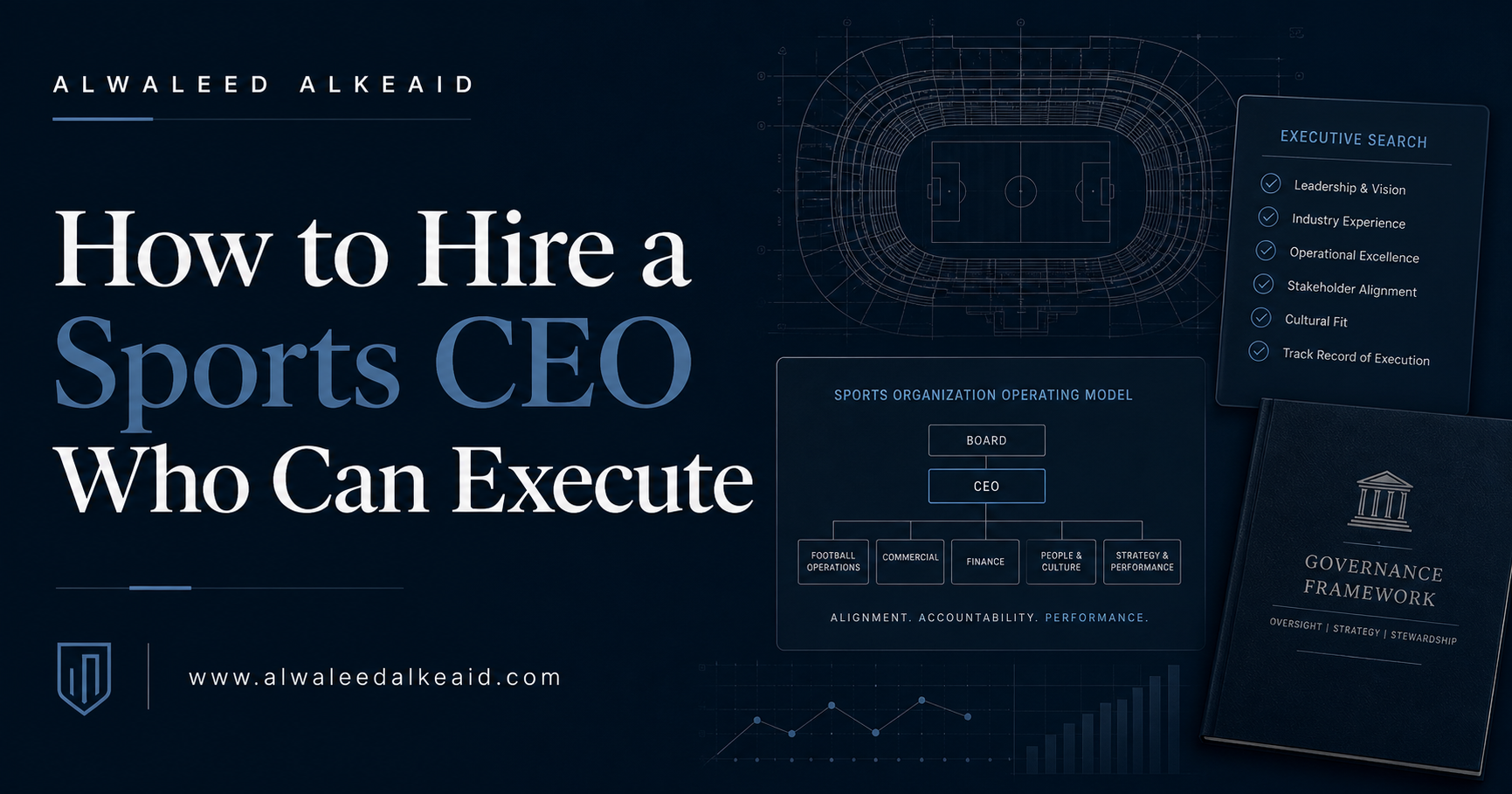
Hiring a sports CEO is one of the most important decisions a club, federation, league, or sports organization can make.
A strong CEO can turn ambition into structure, strategy into execution, and pressure into performance. The wrong CEO, however, can slow down the organization, confuse the team, weaken stakeholder trust, and waste valuable time.
This is why hiring a sports CEO should never be treated as a normal recruitment process.
Sport is different.
A sports CEO must manage emotion, politics, governance, athletes, fans, sponsors, government expectations, media pressure, commercial targets, and long-term development. In many organizations, the CEO also has to work with boards, committees, technical departments, investors, federations, and public stakeholders.
That mix requires more than a good CV.
It requires leadership judgment.
It requires execution ability.
Most importantly, it requires fit.
From my experience in sports leadership, federation work, recruitment, and advisory, many organizations do not fail because they lack ambition. They fail because they hire leaders who look impressive on paper but cannot execute inside the real environment of sport.
A sports CEO should not only know what good looks like.
They must know how to make it happen.
Why the CEO role matters more than many boards realize
The CEO is the link between strategy and execution.
The board may approve the vision. Investors may provide capital. Government may create the opportunity. Fans may bring passion. Sponsors may support the journey.
Still, someone has to turn all of that into daily progress.
That is the CEO’s job.
A sports CEO must build the team, manage priorities, control resources, report honestly, make decisions, and keep the organization moving.
When the role works well, the organization feels clear. Staff understand priorities. Partners receive better communication. The board receives useful reporting. Commercial plans move forward. Technical and operational teams know how their work connects to the wider strategy.
When the CEO role is weak, confusion spreads quickly.
People wait for decisions. Departments operate separately. Board members start stepping into management. Staff lose trust. Partners become frustrated. Strategy becomes a document instead of a working system.
Good governance principles in sport consistently emphasize accountability, transparency, competence, control, athlete involvement, and clear structures. The IOC’s Basic Universal Principles of Good Governance highlight these areas as part of how sports organizations should operate responsibly.
That is why a sports CEO cannot be judged only by personality or reputation.
Boards need to assess whether the person can lead within a governance system.
Mistake 1: Hiring for status instead of execution
Many sports organizations are attracted to big names.
A former athlete.
A well-known executive.
A person with international experience.
A candidate with strong relationships.
A leader from a famous club or major event.
These things can help.
They are not enough.
The real question is not whether the candidate has an impressive background. A better question is whether they can execute in your organization’s context.
Can they build a team?
Will they manage a budget?
Can they handle pressure from the board?
Do they understand local stakeholders?
Will they improve systems?
Can they make difficult decisions?
Do they know how to report progress?
Can they move from strategy to delivery?
A sports CEO with status but no execution discipline can become expensive very quickly.
Boards should respect experience, but they should test capability.
The best CEO candidate is not always the most famous one.
It is the one who can deliver the next phase.
Mistake 2: Hiring without defining the job properly
A weak hiring process starts with a weak role definition.
Many organizations say they need a CEO, but they have not clarified what the CEO must actually solve.
Is the priority commercial growth?
Governance reform?
Club privatization readiness?
Federation restructuring?
Event delivery?
Elite performance?
Financial control?
Stakeholder alignment?
Talent development?
International partnerships?
Each challenge requires a different leadership profile.
A CEO hired to commercialize a club may need strong revenue, sponsorship, venue, and fan engagement experience. Another CEO brought into a federation may need governance, stakeholder management, policy, and development experience.
A major event organization may need a leader with operational discipline and delivery under pressure.
Before searching for a sports CEO, the board should define the mission.
Not just the job title.
The mission.
Without this clarity, the organization risks hiring a good person for the wrong problem.
Mistake 3: Confusing vision with leadership
Many candidates can speak well about vision.
They can present ideas, talk about transformation, use the right language, and impress a board during interviews.
That matters, but it is not enough.
A sports CEO must convert vision into work.
Execution requires prioritization, structure, people management, financial discipline, reporting, and follow-through.
Boards should ask candidates to explain how they delivered results in the past.
What challenge did the candidate face?
What situation did they inherit when they arrived?
Which issue did they address first?
Who did they bring into the team?
What systems or processes did they build?
How did they manage resistance from stakeholders?
Which results can they clearly prove?
Looking back, what would they do differently?
These questions reveal more than polished statements.
A real operator can explain the messy middle.
They can describe the decisions, trade-offs, mistakes, people issues, budget limits, and stakeholder tensions behind the outcome.
That is what boards should listen for.
What a strong sports CEO actually does
A strong sports CEO does not try to do everything personally.
They build an organization that can perform.
This includes several responsibilities.
First, the CEO turns strategy into priorities. Not every idea deserves attention at the same time. The CEO must decide what matters now, what can wait, and what should stop.
Second, they build the leadership team. A CEO cannot execute alone. The quality of the executive team often determines whether the organization can deliver.
Third, they create operating systems. Meetings, reporting, budgets, approvals, performance dashboards, project plans, and accountability rhythms may not sound exciting, but they make execution possible.
Commercial growth is another core responsibility. Even nonprofit and federation environments need stronger financial discipline, partner value, and sustainable revenue thinking.
A capable CEO also protects the relationship between the board and management. The board governs. The CEO leads execution. When that line becomes blurred, the CEO must help restore clarity without creating conflict.
Finally, strong CEOs communicate with clarity and discipline. They raise problems early, avoid overpromising, and give the board, staff, partners, and stakeholders a realistic view of progress.
The profile boards should look for
A strong sports CEO needs a rare mix of skills.
Sporting knowledge matters, but it should not be the only requirement.
Boards should assess candidates across five areas.
1. Governance maturity
The CEO must understand how to work with a board, committees, owners, public stakeholders, and regulators. They need to respect governance without becoming slow.
2. Execution discipline
A good sports CEO knows how to turn plans into action. They manage priorities, timelines, budgets, and accountability.
3. Commercial understanding
Sport needs revenue. Even federations and public-interest organizations need commercial awareness. Sponsorship, partnerships, events, facilities, media, membership, and fan engagement all require leadership.
4. People leadership
The CEO must hire, develop, challenge, and retain talent. Strong leaders build teams, not personal empires.
5. Stakeholder intelligence
Sport is political, emotional, and public. A CEO must manage relationships with athletes, staff, boards, fans, sponsors, government entities, media, and international bodies.
A candidate who is strong in only one area may struggle.
The best sports CEO has range.
Interview questions that reveal execution ability
Boards should avoid soft interviews that only test personality.
A strong interview should test judgment.
Here are practical questions:
Tell us about a strategy you had to execute with limited resources.
What did you change in your first 90 days in your last leadership role?
How do you manage a board that becomes too operational?
Which commercial revenue stream would you prioritize first in our organization, and why?
How do you decide when to replace a senior team member?
Describe a time when a project failed. What did you learn?
How do you build trust with athletes, coaches, and technical staff?
What reporting rhythm would you introduce to this board?
How would you assess our organization’s current operating model?
Which three risks would you focus on first if appointed?
These questions make the candidate think.
They also show whether the person understands reality, not only theory.
The first 90 days matter
A sports CEO’s first 90 days reveal a lot.
This period should not be used only for meetings and introductions. It should create clarity.
During the first month, the CEO should listen carefully, review documents, understand finances, assess people, meet key stakeholders, and identify urgent risks.
In the second month, priorities should become clearer. The CEO should start shaping the operating rhythm, reporting system, leadership structure, and immediate action plan.
By the third month, the board should see direction. Not perfection, but direction.
A strong CEO will usually produce a clear view of:
What is working.
What is broken.
Which roles are missing.
Where money is leaking.
Which partnerships matter.
What the biggest risks are.
How the strategy should be delivered.
What the next 12 months should focus on.
Boards should discuss this before hiring.
The candidate should know what the first 90 days must achieve.
Why the board must also be ready
A sports CEO cannot execute if the board is not ready to govern properly.
This is a hard truth.
Some boards hire a CEO but continue managing daily operations. Others approve a strategy but do not delegate enough authority. A few expect transformation without giving the CEO resources, trust, or clear decision rights.
That does not work.
The role division between the chair, board, and CEO should be clear in writing. Some governance codes in sport explicitly require that the chair and CEO roles remain separate and that the division of responsibilities is written down.
Even where that specific code does not apply, the principle is useful.
The board should govern.
The CEO should execute.
Both sides should respect the system.
If the board is not ready to let the CEO lead, the hiring process will fail no matter how strong the candidate is.
Red flags to watch for
Some candidates look impressive on paper but still carry serious risks.
Boards should pay attention when a candidate:
- Speaks in broad language but cannot explain how they execute.
- Links most achievements to famous organizations without showing their personal contribution.
- Avoids discussing failure or lessons learned.
- Struggles to explain how they manage budgets.
- Blames every past problem on someone else.
- Shows limited respect for governance and board oversight.
- Has a strong network but weak operating discipline.
- Focuses only on elite performance while ignoring commercial sustainability.
- Wants authority but resists accountability.
- Cannot explain what they would do in the first 90 days.
One red flag may not disqualify a candidate.
Several should slow the process down.
How to run a better hiring process
A strong sports CEO hiring process should include more than interviews.
Start with a clear role brief. Define the mission, reporting line, authority, board relationship, key challenges, and success measures.
Next, map the market properly. Do not rely only on familiar names. Look across clubs, federations, leagues, events, venues, sports businesses, entertainment, tourism, and high-performance environments.
After that, shortlist based on fit, not fame.
Use structured interviews, case exercises, stakeholder discussions, reference checks, and scenario questions.
A board should also test how the candidate thinks about your organization.
Ask them to prepare a short diagnosis. What do they see? What would they prioritize? Which risks worry them? What would they need from the board?
This gives the board a better view of judgment and style.
Hiring a sports CEO should feel like selecting a partner in execution, not just filling a vacancy.
Why this matters for Saudi and GCC sport
Saudi Arabia and the GCC are entering a more demanding sports era.
Club privatization, federation development, major events, commercial growth, venue investment, women’s sports, esports, sports tourism, and the 2034 World Cup will all increase the need for stronger leadership.
The market does not only need more sports executives.
It needs executives who can execute.
A CEO in this environment must understand transformation, governance, people, commercial value, public stakeholders, and international expectations.
For many clubs and federations, the next CEO hire may define the next five years.
That is why sports executive recruitment should be strategic, not reactive.
A practical checklist before hiring a sports CEO
Before appointing a sports CEO, the board should ask:
Have we defined the real mission of the role?
Do we know which problem this CEO must solve first?
Is the board ready to delegate authority?
Have we clarified the reporting line and decision rights?
Do we know what success looks like after 90 days, 12 months, and three years?
Have we tested execution ability, not only personality?
Did we check references properly?
Can the candidate manage governance, people, money, and stakeholders?
Will this person build systems or depend only on personal relationships?
Are we hiring for the future we want, or the pressure we feel today?
These questions protect the organization.
They also improve the chance of hiring someone who can actually deliver.
Hire for execution, not appearance
Hiring a sports CEO is a strategic decision.
The right person can professionalize the organization, strengthen governance, build teams, improve commercial performance, manage stakeholders, and turn strategy into results.
The wrong person can create confusion, delay progress, and damage trust.
Boards should not hire only for reputation, relationships, or presentation skills.
They should hire for execution.
A sports CEO who can actually execute will bring clarity, discipline, leadership, and momentum. They will respect governance, build systems, develop people, and focus the organization on what matters most.
Sport does not need more impressive titles.
It needs leaders who can deliver.
If your club, federation, league, or sports organization is preparing to hire a CEO, secretary general, executive director, or senior sports leader, the first step is role clarity.
I work with sports organizations on sports executive recruitment, leadership structure, sports strategy and governance advisory, and executive hiring systems that help boards select leaders who can actually execute.