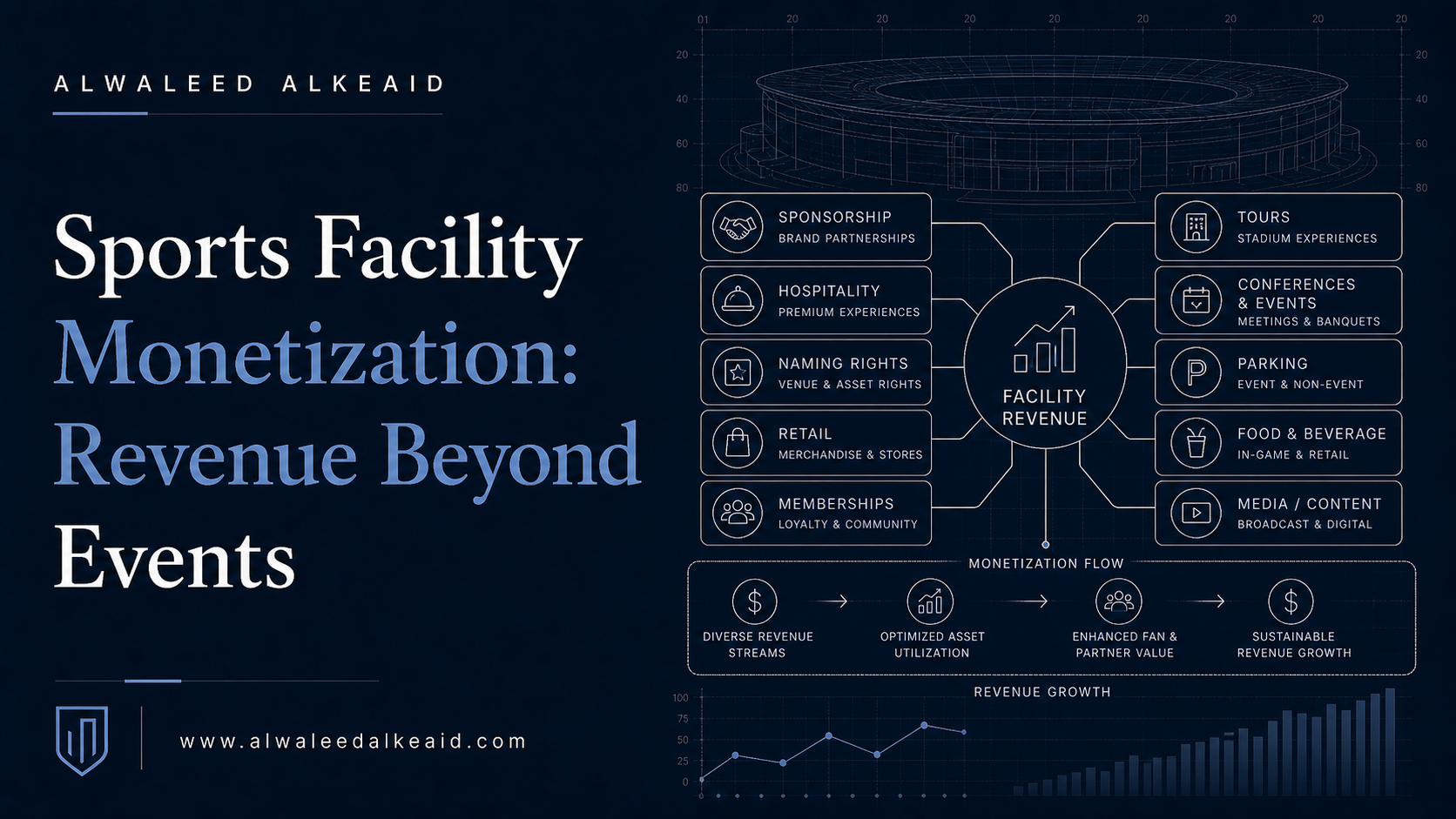
Sports facility monetization is becoming one of the most important questions for clubs, federations, municipalities, venue operators, and sports investors.
A stadium, arena, training center, sports city, academy facility, or community venue should not only generate revenue on event days. If the business model depends only on matches, tournaments, or occasional major events, the venue will remain underused for most of the year.
That is a problem.
Sports facilities are expensive to build, operate, maintain, staff, secure, clean, and upgrade. Without a clear commercial model, even beautiful venues can become financial burdens.
The stronger question is not, “How do we fill the venue for one event?”
The better question is, “How can this facility create value throughout the year?”
Saudi Arabia is moving in this direction. In May 2025, the Ministry of Sport launched the “Sports Facilities Investment” project through the Furas Portal, covering King Abdullah Sports City in Jeddah, Prince Abdullah Al-Faisal Sports City in Jeddah, and King Abdulaziz Sports City in Makkah. The Ministry stated that the project aims to increase private sector participation, improve facility operations, and create investment opportunities across major sports facilities.
That shift matters.
Sports facility monetization is no longer just an operational issue. It is now a strategy issue, an investment issue, and a leadership issue.
Why Venues Need Business Models, Not Just Events
Many sports organizations think about venues as physical assets.
A stadium.
A hall.
A training pitch.
A gym.
A sports complex.
A fan zone.
A hospitality area.
That thinking is too limited.
A venue is not only a place where sport happens. It can become a commercial platform, a community hub, a media asset, a tourism product, a wellness destination, and a sponsorship environment.
The challenge is that many venues do not operate that way.
They depend on a small number of major events. Outside those dates, the facility may be quiet, expensive to maintain, and commercially underused.
This is where sports facility monetization becomes essential.
A strong venue model should answer:
Who uses the facility?
When do they use it?
What can they pay for?
Which spaces are underused?
Which partners can activate inside the venue?
How can the facility serve the community?
What revenue streams exist beyond ticket sales?
How does the venue support the wider sports ecosystem?
Without these answers, the facility is just infrastructure.
With the right model, it becomes an asset.
The Saudi Opportunity for Sports Facilities
Saudi Arabia’s sports sector is entering a more commercial phase.
Major events, club privatization, private sector investment, sports tourism, and Vision 2030 quality-of-life goals are creating new expectations for sports venues.
The Ministry of Sport also offers investment opportunities through the reservation of sports facilities for sports, entertainment, and other events for up to three months during the year. This shows that facility use is expanding beyond traditional sports programming.
That is important for Saudi clubs, federations, and venue operators.
The future of sports infrastructure in the Kingdom should not only be measured by construction quality. It should be measured by utilization, revenue, community access, commercial partnerships, and long-term operating performance.
A facility that hosts one major event but remains empty afterward is not reaching its potential.
A facility that supports sport, business, wellness, education, entertainment, tourism, and community programming can become much more valuable.
Start With Asset Clarity
Sports facility monetization starts with knowing what you actually control.
Many organizations cannot clearly explain their facility rights, commercial assets, restrictions, costs, or usage patterns.
That creates confusion.
Before building a monetization plan, leaders should map every asset inside the venue:
Main field or court.
Training areas.
Hospitality suites.
Meeting rooms.
Retail space.
Food and beverage zones.
Parking areas.
Digital screens.
Naming rights inventory.
VIP entrances.
Fan zones.
Community spaces.
Academy facilities.
Outdoor areas.
Each space should have a purpose.
Some areas can generate direct revenue. Others may support sponsorship value, community engagement, fan experience, or athlete development.
A proper asset map helps leaders see the venue differently.
Instead of asking, “What do we have?”
They begin asking, “What value can each part of this facility create?”
Naming Rights Can Create Long-Term Value
Naming rights are one of the clearest sports facility monetization tools.
A naming rights deal can provide predictable income, strengthen the venue’s commercial profile, and create a long-term partnership between a brand and a sports asset.
Saudi Arabia has already moved in this direction. In February 2025, the Ministry of Sport announced that Alinma Bank won the naming rights investment contract for King Abdullah Sports City Stadium in Jeddah until 2029, with the stadium renamed “Alinma Stadium.”
That is a major signal for the market.
Naming rights are not just about placing a brand name on a building.
A strong naming rights strategy should include brand integration, hospitality, digital content, fan experience, community programming, signage, media exposure, and measurable partnership value.
The mistake is treating naming rights as a one-time sale.
The opportunity is to turn it into a long-term commercial relationship.
For clubs, federations, and venue operators, the question is not only, “Who will pay for the name?”
A better question is, “Which brand can help activate this venue and create shared value?”
Hospitality and Premium Experiences
Hospitality is one of the strongest ways to increase venue revenue.
Premium seating, private suites, business lounges, VIP entrances, curated food and beverage, networking events, and corporate packages can all create higher-value revenue streams.
This matters because not every fan or sponsor wants the same experience.
PwC’s research on high-income sports fans found that premium fans are willing to spend on access, status, personalization, merchandise, exclusive platforms, and luxury suites. PwC also noted that sports properties are looking to deepen fan relationships by improving experiences inside and outside venues.
That has direct relevance for sports facility monetization.
A venue should not only sell seats.
It should sell experiences.
For Saudi Arabia and the GCC, hospitality can become a major growth area. Sports venues can serve business leaders, sponsors, families, government guests, international visitors, and premium fan segments.
The key is design.
Premium experiences must feel intentional, not improvised. Pricing, service, access, branding, food, comfort, privacy, and storytelling all matter.
Community Use and Daily Programming
A venue that only opens for major events loses value.
Daily and weekly programming can turn sports facilities into community assets.
This can include:
Youth academies.
School tournaments.
Corporate wellness sessions.
Fitness classes.
Women’s sports programs.
Community leagues.
Coach education.
Referee training.
Sports camps.
Walking clubs.
Recovery and wellness services.
Local federation programs.
Community programming may not always generate the highest immediate revenue, but it creates long-term value.
It increases utilization. Builds loyalty. Supports participation. Creates future fans. Strengthens the venue’s public value. Gives sponsors more activation opportunities.
This is especially important for public or government-linked sports facilities.
A venue should not only serve elite sport.
It should serve the ecosystem around sport.
Retail, Food, and Merchandise
Retail and food and beverage often receive less strategic attention than they deserve.
A venue can generate revenue through merchandise stores, pop-up retail, club shops, cafés, healthy food concepts, sponsor-branded kiosks, sports equipment sales, and event-specific products.
This requires more than opening a shop.
Leaders need to understand fan behavior.
What do visitors want before the event?
What do families buy?
Which products work for tourists?
Can merchandise connect to clubs, athletes, academies, or events?
Could digital ordering improve the experience?
Can sponsors support food or retail activations?
Small revenue streams can become meaningful when they operate consistently.
Retail and food also influence fan experience. A poor experience can damage the event. A strong one can increase spending, satisfaction, and repeat visits.
Data and Digital Fan Engagement
Modern venue monetization depends on data.
Ticketing, entry scans, purchases, memberships, Wi-Fi use, app activity, merchandise sales, content engagement, and loyalty programs can all help a venue understand its audience.
Deloitte has argued that analytics can improve live sports experiences, maintain fan and sponsor participation, and create revenue-generating ideas around attendance, engagement, and sponsorship.
That is the future of sports facility monetization.
A venue with data can price better, program better, sell sponsorship better, and personalize the fan experience.
Without data, decisions depend too much on assumptions.
Digital fan engagement also expands revenue beyond the physical visit. A venue can use memberships, apps, newsletters, exclusive content, loyalty rewards, and digital commerce to keep fans connected throughout the year.
The venue becomes more than a location.
It becomes part of a fan relationship.
Partnerships Beyond Sport
Not every revenue opportunity needs to come from sport.
Sports facilities can host conferences, product launches, concerts, exhibitions, graduation ceremonies, corporate events, wellness retreats, community festivals, training workshops, and cultural activations.
This does not mean every venue should become a general events hall.
Brand fit still matters.
A sports venue should protect its identity while expanding its use. The best non-sport events are those that support the venue’s commercial goals, community role, and operational capacity.
For example, a sports city can host wellness expos, youth leadership programs, school sports days, sports business forums, and corporate team-building events.
These activities create revenue and keep the facility active.
They also introduce new audiences to the venue.
Facility Operations Must Become Professional
Commercial ideas only work if operations are strong.
A venue cannot monetize properly if booking systems are weak, maintenance is poor, staff are undertrained, safety standards are unclear, or customer experience is inconsistent.
Sports facility monetization requires professional operations.
That includes:
Clear booking procedures.
Transparent pricing.
Maintenance planning.
Event readiness checklists.
Safety and security systems.
Cleaning standards.
Customer service training.
Technology support.
Supplier management.
Financial reporting.
Post-event evaluation.
Venue leaders should know the cost and margin of different activities.
Not every event is profitable. A crowded calendar does not always mean a healthy business model.
Strong operators understand utilization, revenue, cost, risk, and experience together.
What Boards and Executives Should Measure
A facility monetization strategy needs clear metrics.
Boards and executives should not only ask whether the venue is busy.
They should ask whether it is creating sustainable value.
Useful metrics include:
Utilization rate.
Revenue per space.
Event profitability.
Non-event day revenue.
Hospitality sales.
Sponsorship revenue.
Community participation.
Customer satisfaction.
Maintenance cost.
Repeat bookings.
Retail and food sales.
Digital engagement.
Partner renewal rate.
These numbers help leaders make better decisions.
A venue may look successful because it hosts many activities. Deeper reporting may show that some activities lose money, damage the facility, or create little strategic value.
Measurement brings discipline.
A Practical Revenue Map for Sports Venues
Sports facilities can build revenue across several areas:
Naming rights and sponsorship.
Hospitality and premium seating.
Ticketed sports events.
Non-sport events.
Facility rentals.
Academies and training programs.
Memberships.
Retail and merchandise.
Food and beverage.
Parking.
Digital content.
Data-driven partnerships.
Community programs.
Corporate wellness.
Conferences and business events.
The strongest venues do not depend on only one or two revenue streams.
They create a balanced portfolio.
Some revenue is event-based. Other revenue is recurring. A few streams support commercial value indirectly by improving fan data, community trust, or sponsor activation.
A smart model combines all three.
Why This Matters for Saudi Sport
Saudi Arabia is investing heavily in sports infrastructure, events, clubs, tourism, and quality of life.
That creates a major opportunity.
It also creates a responsibility.
Sports facilities should not become underused assets. They should become active platforms that support participation, commercial growth, community development, tourism, and private sector engagement.
For clubs, facility monetization can support financial sustainability.
For federations, it can create better access to training, competitions, and development programs.
Investors will look at venue utilization, revenue potential, operating discipline, and commercial rights.
For cities and communities, active sports facilities can improve quality of life and create more reasons for people to move, gather, and participate.
This is why sports commercial strategy must include facilities.
A sports venue is not only an expense line.
Managed properly, it becomes part of the growth engine.
A Checklist Before Launching a Monetization Plan
Before launching a venue revenue strategy, leaders should ask:
Do we know every asset inside the facility?
Can we explain our current utilization rate?
Which spaces are underused?
What can generate recurring revenue?
Do we have a naming rights or sponsorship strategy?
Are hospitality and premium experiences properly packaged?
Can the community use the venue regularly?
Is our booking system clear and professional?
Do we track revenue by activity and space?
Which partners can help activate the facility?
Do we have the right team to manage the model?
Can we report performance to boards, investors, or government stakeholders?
These questions are practical.
They show whether the venue has a business model or only a calendar.
Venues Should Work Harder
Sports facility monetization is no longer optional.
As sports investment grows, venues must generate value beyond major events. Stadiums, arenas, training centers, sports cities, and community facilities need clearer commercial models, better programming, stronger partnerships, and more professional operations.
The opportunity is significant.
Naming rights can create long-term income. Hospitality can raise revenue per visitor. Community programs can increase utilization. Retail and food can improve spending. Data can improve sponsorship. Non-sport events can fill the calendar. Strong operations can protect the asset.
Yet none of this happens by accident.
A facility needs strategy, leadership, people, systems, and measurement.
The best sports venues of the future will not only host events.
They will operate as year-round platforms for sport, business, wellness, entertainment, tourism, and community life.
That is where real value begins.
If your club, federation, sports organization, venue operator, or investment group is reviewing how to generate more value from sports facilities, the first step is a clear commercial and operating model.
I work with sports leaders and organizations on sports commercial strategy, sports strategy and governance advisory, facility monetization, operating models, and execution systems that help turn sports assets into sustainable value.