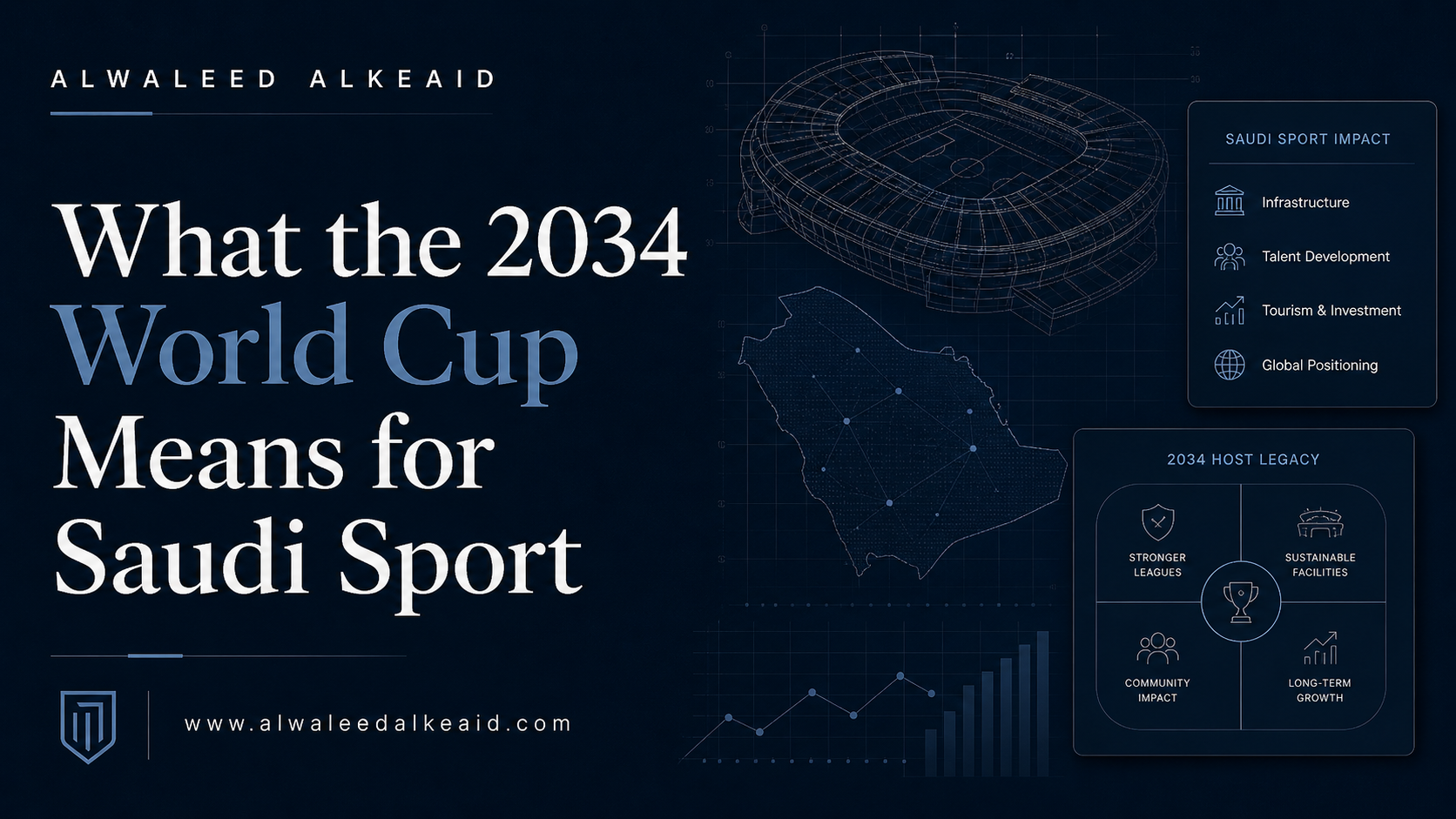
The 2034 World Cup is not only a football tournament for Saudi Arabia. It is a major test of how ready Saudi sports institutions are to govern, deliver, professionalize, and build long-term legacy.
FIFA confirmed Saudi Arabia as host of the FIFA World Cup 2034 on December 11, 2024, placing the Kingdom at the center of the global football calendar.
That is historic.
It also changes the level of responsibility.
Hosting the World Cup will bring global attention, international fans, sponsors, media, football leaders, investors, and scrutiny. Stadiums, transport, hotels, fan zones, training sites, and match operations will matter. Yet the deeper question is not only whether Saudi Arabia can host a successful tournament.
The bigger question is whether Saudi sports institutions can use the 2034 World Cup to become stronger, more professional, and more sustainable.
A World Cup lasts for weeks.
Institutional legacy should last for decades.
Why this moment matters for Saudi sports institutions
Saudi Arabia has already shown ambition in sport.
Major international events have been hosted. Club privatization is moving forward. Sports investment is increasing. Women’s sports are growing. Football is receiving global attention. Participation and quality-of-life programs are becoming part of national development.
The 2034 World Cup raises the standard for all of this.
Saudi Arabia’s official World Cup platform describes the tournament as connected to Vision 2030 and the Kingdom’s broader transformation, with sport, tourism, and quality of life forming part of the national story.
For sports institutions, that connection matters.
A federation cannot think only about tournaments. A club cannot focus only on match results. An academy cannot operate without a player pathway. A venue cannot depend only on major events. A sports organization cannot build credibility without governance, talent, reporting, and execution discipline.
The 2034 World Cup should push every sports institution in Saudi Arabia to ask a difficult question:
Are we building for the tournament, or are we building beyond it?
Hosting is not the same as institutional legacy
Saudi Arabia’s World Cup plans include 15 proposed stadiums across 5 host cities, along with 10 other host locations proposed mainly to support team base camps.
That scale is impressive.
But stadiums alone do not create legacy.
Legacy comes from what those stadiums enable after the tournament: stronger clubs, better venue operations, more community programs, improved commercial models, deeper fan engagement, and more capable local professionals.
Too many countries and cities learn this lesson late. They build infrastructure for a major event but fail to connect it to long-term institutional use.
Saudi Arabia has the opportunity to do this differently.
Every stadium, training site, and host location should have a post-2034 operating model. Who will use it? How will it generate revenue? Which clubs, academies, schools, federations, and communities will benefit? What programming will keep it active after the tournament ends?
A venue without a post-event plan becomes a cost.
A venue with a strong operating model becomes a sports asset.
Governance will face a pressure test
The 2034 World Cup will test governance across Saudi sport.
Not only at the national organizing level, but also across federations, clubs, municipalities, suppliers, venues, academies, and partner organizations.
Major tournaments create complexity.
Decisions must move quickly. Budgets must be controlled. Stakeholders must align. Risks must be managed. Reports must be accurate. Roles must be clear. Public communication must be disciplined.
Weak governance becomes visible under pressure.
A board that interferes in operations slows execution. An executive team with unclear authority struggles to deliver. Committees without mandates create confusion. Partners without reporting discipline increase risk.
This is why sports federation governance and club governance must improve before 2034, not during the final preparation phase.
Strong governance does not slow organizations down.
It helps them move faster because people know who decides, who executes, who reports, and who is accountable.
Football development cannot depend on the tournament alone
The World Cup will create attention around football.
Attention is valuable, but development needs structure.
Saudi football needs more than elite transfers, international events, and major stadiums. It needs stronger youth pathways, better coaching education, clear academy models, technical leadership, competition systems, sports science, scouting, women’s football development, and stronger club operations.
The 2034 World Cup should accelerate these systems.
Young players need more than inspiration. They need places to train, coaches who can develop them, competitions that test them, and clubs that can guide their progress.
Women’s football should also be part of the legacy conversation. A World Cup can inspire more girls and women to participate, but participation will only grow sustainably if clubs, schools, academies, and federations create real pathways.
The question is not only how Saudi Arabia performs as host.
A better question is how Saudi football becomes stronger because of hosting.
The workforce challenge starts now
The 2034 World Cup will require a deep sports workforce.
Saudi Arabia will need people across football operations, venue management, event delivery, volunteering, fan experience, media, broadcast, hospitality, security, transport, logistics, commercial operations, sponsorship activation, accreditation, medical services, technology, and legacy programs.
Infrastructure can be built faster than people.
That is why workforce planning must start early.
The tournament should become a national training platform for Saudi professionals. Every major event before 2034 should develop talent, transfer knowledge, and create real experience for local teams.
Saudi sport should not only ask, “Who can deliver the World Cup?”
It should also ask, “Who will lead Saudi sport after the World Cup?”
That second question is the legacy question.
This is where sports executive recruitment and workforce planning become strategic priorities.
Clubs should prepare for a different level of expectation
The 2034 World Cup will increase expectations on Saudi clubs.
Fans will expect better matchday experiences. Sponsors will expect stronger commercial packages. Investors will expect clearer reporting. Players will expect better technical environments. Media will expect professionalism. Communities will expect access and engagement.
Clubs that still operate informally will struggle.
The next phase requires better governance, clearer operating models, stronger commercial teams, professional CEOs, technical directors, academy leaders, facility managers, and fan engagement systems.
This is especially important as Saudi sports privatization continues. The Ministry of Sport describes the Sports Clubs Investment and Privatization Project as a way to enable private sector participation, improve club operations and governance, grow revenues, reduce cost bases, and build a more sustainable sports system.
Privatization and the 2034 World Cup should not be treated as separate stories.
Both push clubs toward the same future: more professional institutions.
Commercial maturity will become essential
The World Cup will attract sponsors, brands, broadcasters, hospitality partners, tourism operators, and global companies.
That creates opportunity.
It also creates pressure.
Sports institutions need stronger commercial systems before they can fully benefit. Sponsorship cannot remain a logo-selling exercise. Venues cannot depend only on matchdays. Fan engagement cannot be treated as social media posting. Partnerships cannot be managed without measurement.
Saudi clubs, federations, and event owners need to understand their audiences, package rights properly, create activation ideas, report value, and build long-term partnerships.
Commercial maturity means moving from “we need sponsors” to “we can create value for sponsors.”
That shift matters before 2034.
Organizations that build commercial systems now will be better positioned when global attention increases.
Delivery standards will define the experience
Every World Cup is judged by more than what happens on the pitch.
Fans, teams, media, sponsors, officials, and partners will all experience the tournament through the quality of its delivery.
That means standards matter.
Venue operations matter.
Transport coordination matters.
Fan experience matters.
Volunteer training matters.
Media services matter.
Supplier management matters.
Safety, accessibility, communication, and hospitality all matter.
For Saudi sports institutions, this is a major opportunity.
The 2034 World Cup can help raise the standard of how sports events are planned, staffed, operated, and evaluated across the Kingdom.
This is not only about delivering a successful tournament.
It is about building a higher level of professional capability inside clubs, federations, venues, event companies, and sports organizations.
If done well, the experience gained before and during 2034 can improve how Saudi sport delivers events for many years after the final match.
The world will watch the football.
But the people attending, working, competing, and partnering will also remember the quality of the experience.
That is where institutions prove their readiness.
What the 2034 World Cup should change inside institutions
The World Cup should not only change infrastructure.
It should change how Saudi sports institutions operate.
Clubs should become more professional.
Federations should strengthen governance and athlete pathways.
Venues should operate with long-term commercial models.
Academies should build clearer player development systems.
Universities and training providers should align programs with real sports workforce needs.
Private companies should create practical pathways into sports careers.
Government-linked entities should require knowledge transfer in major event contracts.
Each institution has a role.
The World Cup should become a shared national capability project, not only a football event.
A practical readiness checklist for leaders
Before 2034, every sports institution should ask:
Do we have clear governance and decision rights?
Can our operating model support growth?
Are our leadership roles defined?
Do we have the right people in critical positions?
Can we develop local talent through events and programs?
Do our facilities have post-event business models?
Are our commercial rights properly packaged?
Can we report performance clearly to stakeholders?
Do we have integrity, safeguarding, and risk systems in place?
Will our organization be stronger after 2034 than it is today?
These questions are simple.
The answers will show whether an institution is preparing for legacy or only reacting to the event.
What sports leaders should do next
Saudi sports leaders should start with honest diagnosis.
Every club, federation, venue, academy, and sports entity should review its current readiness. That review should cover governance, talent, finances, operations, commercial systems, facilities, technology, risk, and stakeholder management.
After that, leaders should prioritize the gaps that matter most.
Some organizations will need governance reform. Others will need stronger executive leadership. A few may need better commercial planning, while many will need workforce development and operating model clarity.
The next step is implementation.
Plans must turn into job descriptions, policies, training programs, reporting rhythms, commercial packages, facility plans, and performance dashboards.
The 2034 World Cup is still years away.
That is exactly why the work should begin now.
The tournament is a deadline, not the destination
The 2034 World Cup will be one of the most important moments in Saudi sports history.
It will bring global attention, national pride, tourism, investment, football excitement, and international visibility.
But for Saudi sports institutions, the tournament should mean something deeper.
It should be a deadline for professionalization.
A deadline to improve governance, build talent, strengthen clubs, develop football pathways, make venues commercially useful, and a deadline to turn event hosting into institutional capability.
The real legacy of the 2034 World Cup will not only be measured by stadiums, attendance, or global headlines.
It will be measured by the institutions Saudi sport has built by the time the tournament ends.
Ambition won the right to host.
Systems, people, and institutions will decide what hosting leaves behind.
If your club, federation, sports organization, academy, or event company is preparing for Saudi Arabia’s next phase of sports growth, the first step is institutional readiness.
I work with sports leaders and organizations on sports strategy and governance advisory, sports executive recruitment, operating models, workforce planning, and execution systems that help turn major opportunities into sustainable performance.