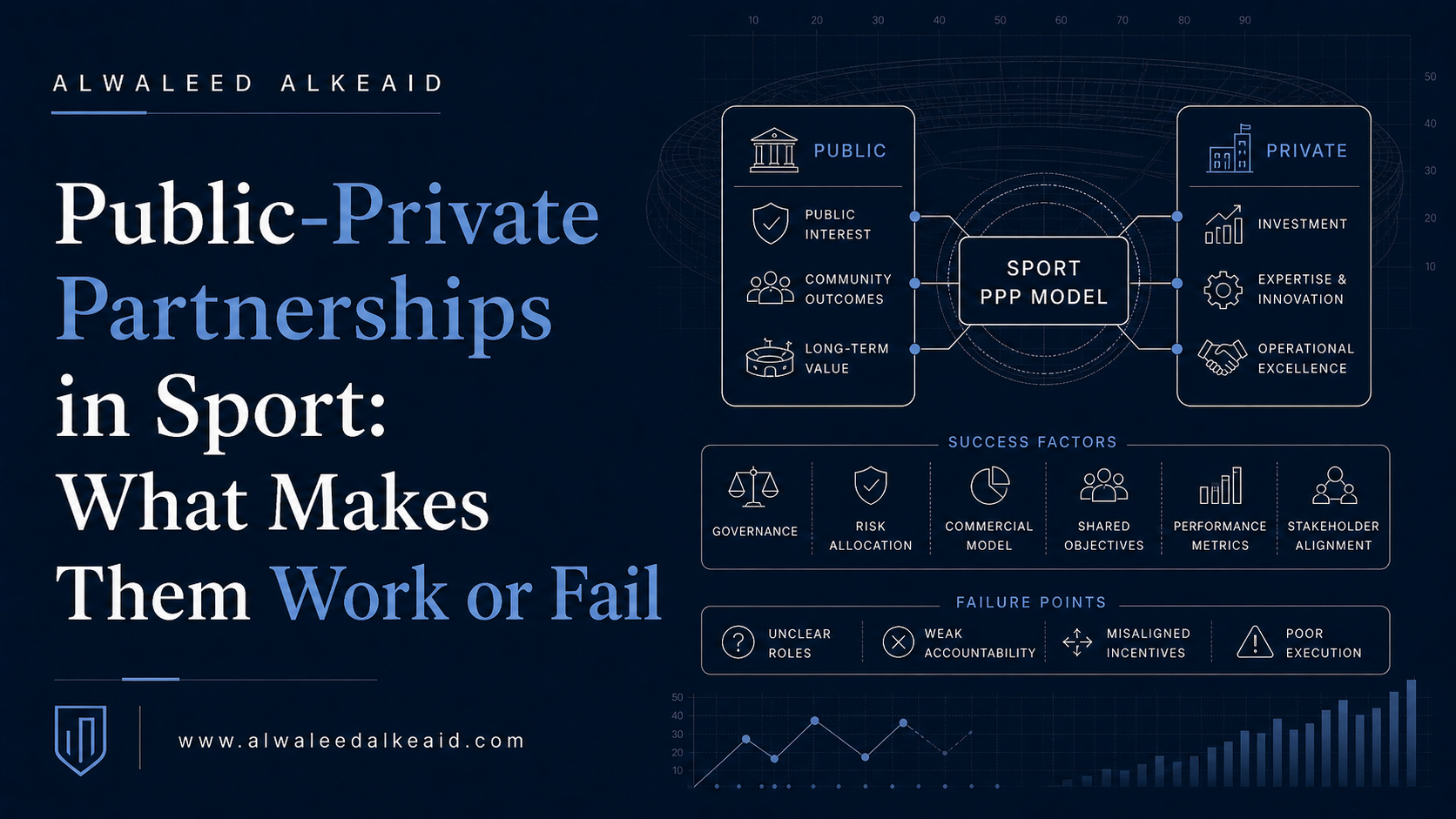
Public-private partnerships in sport can help governments, clubs, federations, municipalities, and private operators build better facilities, activate sports assets, improve service quality, and create long-term value.
They can also fail.
A partnership may look strong in a press release, but struggle later because the operating model is unclear, risk is poorly allocated, public objectives are vague, private incentives are misaligned, or the project depends on unrealistic revenue assumptions.
This is why public-private partnerships in sport should never be treated as simple funding arrangements.
A strong PPP is not only about bringing private money into a sports project. It is about aligning public value with private capability.
Saudi Arabia is moving further in this direction. In 2025, the Ministry of Sport, in collaboration with the National Center for Privatization & PPP and Riyadh Region Municipality, launched the Expression of Interest and Request for Qualification phase for the Prince Faisal bin Fahad Sports City PPP project. The project will follow a Design, Build, Finance, Operate, Maintain model with a 20 to 30 year contract term.
That matters for Saudi sport.
As sports facilities, club privatization, major events, and Vision 2030 projects expand, partnerships between the public and private sectors will become more important.
The opportunity is real.
So is the risk.
Why sports PPPs are becoming more important
Sport is no longer only about competition.
It now connects to health, tourism, entertainment, urban development, private investment, youth development, commercial growth, and quality of life.
That makes sports projects more complex.
A stadium may need to serve professional sport, community programs, concerts, hospitality, schools, sponsors, and tourists. A sports city may include training facilities, retail, wellness, entertainment, academies, parking, food and beverage, and event operations.
The public sector may own the asset or define the national objective. The private sector may bring capital, delivery expertise, operational discipline, technology, customer service, and commercial creativity.
When public-private partnerships in sport work well, both sides benefit.
The public side gains better infrastructure, stronger services, broader access, and reduced operational burden. Private partners gain commercial opportunity, long-term operating rights, brand value, and growth potential.
Problems begin when the partnership lacks clarity.
A PPP cannot succeed if the public side wants community access but the private side depends only on premium revenue. The same issue appears when government expects long-term maintenance, but the operator focuses only on short-term income.
Alignment must come first.
Start with public value, not only private capital
The first question should not be, “How do we attract a private partner?”
A better question is, “What public value should this project create?”
That value may include community participation, youth development, sports tourism, better facilities, health outcomes, economic activity, stronger clubs, women’s participation, or more efficient asset use.
Only after defining the public value should leaders design the partnership model.
OECD guidance on infrastructure governance emphasizes value for money, fiscal discipline, transparency, and prudent management of fiscal risks when governments use private investment models. It also warns that private investment structures should not hide liabilities or weaken public accountability.
This is important in sport.
A sports PPP may look attractive because it reduces upfront public spending. Yet if the contract creates poor service, limited access, unclear obligations, or future financial pressure, the project may not create real value.
The public side must define success clearly.
The private side must understand what it is expected to deliver.
The operating model decides everything
A sports PPP can fail when the operating model is vague.
The agreement may define the asset, contract length, investment amount, and basic responsibilities. Those details matter, but they are not enough.
Leaders need to understand how the facility, club, program, or asset will work after the contract starts.
The model should clearly define who operates the venue and who maintains it. It should also explain who owns programming, how community access will work, and which revenue streams belong to the private partner.
Service standards need to be clear from the beginning. The public side should know how it will monitor performance, while both parties should agree on who handles upgrades, repairs, safety, and technology.
The agreement should also explain what happens if revenue falls below expectations.
Without these answers, the partnership can quickly become a source of conflict.
In sport, the operating model matters because the asset rarely serves one purpose. A facility may support elite athletes in the morning, schools in the afternoon, sponsors during events, and families on weekends.
That complexity requires planning.
A good PPP contract should not only say who pays.
It should explain how the asset creates value every week.
Risk should sit with the party that can manage it
Risk allocation is one of the most important parts of public-private partnerships in sport.
The World Bank’s PPP guidance explains that risks should sit with the party best placed to manage them in a cost-effective way. It also notes that risk transfer to the private side is not the goal by itself. The goal is to align responsibilities with capability and public interest.
This principle matters.
If the private operator controls maintenance, it should carry performance responsibility for maintenance. When government controls approvals, permits, or public access rules, it should not push all delay risk to the private partner.
Poor risk allocation makes projects fragile.
If too much risk sits with the private partner, investors may increase pricing, demand guarantees, or avoid the project. On the other hand, if the public side carries too much risk while the private side captures upside, the public value becomes weak.
Sports projects include many risk categories:
Construction risk.
Demand risk.
Maintenance risk.
Event calendar risk.
Revenue risk.
Technology risk.
Safety risk.
Regulatory risk.
Community access risk.
Reputation risk.
Each one needs a clear owner.
Good PPPs do not eliminate risk.
They manage it honestly.
Revenue assumptions must be realistic
Many sports PPPs fail because the revenue story is too optimistic.
A venue may assume constant event demand. A sports city may expect high commercial rental income. A club project may depend on sponsorship growth that has not been validated. Community usage may increase, but not enough to cover operating costs.
Sport creates emotion, but investors need numbers.
A strong commercial plan should test different revenue streams:
Events.
Facility rental.
Hospitality.
Naming rights.
Sponsorship.
Retail.
Food and beverage.
Academies.
Community programs.
Parking.
Conferences.
Corporate wellness.
Memberships.
Digital engagement.
Saudi Arabia has started opening more sports asset opportunities to private sector participation. The Ministry of Sport offers facility reservation opportunities that allow investors to use sports assets and facilities for sports, entertainment, and other events for up to three months during the year.
That is a positive direction.
Still, facility access does not guarantee profitability.
Revenue depends on programming, pricing, audience demand, operating discipline, partner quality, and consistent activation.
Before entering a PPP, both sides should stress-test the model.
A good question is simple:
Can this project survive a weaker-than-expected commercial year?
Governance must be clear before the contract starts
A PPP needs governance before it needs publicity.
Once a sports project involves public entities, private partners, contractors, operators, sponsors, clubs, communities, and regulators, decision-making can become complicated.
Strong governance should define:
Who approves major changes?
Who monitors performance?
Which reports are required?
How often will reviews happen?
Who manages disputes?
Which decisions need public approval?
What happens if standards are not met?
How can the contract adapt over time?
The OECD’s principles for public governance of PPPs focus on institutional frameworks, value for money, integrity, transparency, and management of fiscal risks.
Sports leaders should treat these principles seriously.
A weak governance model can turn a promising sports PPP into a slow and frustrating relationship.
A strong model creates trust, speed, and accountability.
The private partner must bring more than money
Not every private partner is the right partner.
Some bring capital but lack sports operating experience. Others know events but do not understand community access. A few may understand real estate better than sport, which can shift the project away from its original purpose.
Sports assets require specific capability.
The right private partner should bring operational knowledge, commercial strategy, customer experience, maintenance discipline, staffing systems, technology, safety standards, and reporting quality.
They should also understand the culture of sport.
A venue is not a normal building. A club is not a normal company. A federation is not a normal nonprofit. Fans, athletes, communities, sponsors, and public stakeholders all shape the environment.
A strong partner respects that complexity.
The weakest PPPs happen when private partners treat sports assets only as real estate or event space.
The strongest ones understand that sport carries identity, emotion, community value, and public responsibility.
Public access must be protected
Sports PPPs can create commercial value, but they must not forget public access.
If a publicly owned sports facility becomes too expensive, too exclusive, or too disconnected from community needs, the partnership may lose legitimacy.
This is especially important for projects linked to quality of life, youth development, participation, and health.
Public value should be built into the operating model.
That may include reserved community hours, school access, affordable programming, women’s sports sessions, youth training, federation use, disability access, or grassroots events.
Private partners can still generate returns.
The key is to define public access clearly before the project starts.
If community use becomes an afterthought, commercial pressure will usually dominate.
A well-designed PPP balances public purpose with private incentives.
Performance must be measured, not assumed
Sports PPPs need measurable performance standards.
It is not enough to say the private partner will “operate professionally” or “support community sport.” Leaders need clear indicators.
Possible measures include:
Facility utilization.
Maintenance quality.
Event delivery standards.
Community participation.
Revenue performance.
Customer satisfaction.
Safety compliance.
Access for priority groups.
Partner activation.
Reporting timeliness.
Energy and sustainability targets.
Post-event evaluation.
Measurement protects both sides.
The public side can monitor value. The private partner can prove delivery. Investors can assess performance. Communities can see whether promises became reality.
Without measurement, disagreements become emotional.
With measurement, the partnership becomes easier to manage.
Why sports PPPs fail
Most failed PPPs do not collapse because of one issue.
They weaken through a combination of problems.
The public objective was unclear. Revenue assumptions were too optimistic. Risk allocation did not match real control. Governance was weak. The private partner lacked sports capability. Community access was not protected. Reporting standards were loose. The operating model did not match the reality of the asset.
Each issue creates pressure.
Together, they damage trust.
A sports PPP can still recover if both sides identify problems early and fix them. However, that requires transparency, leadership, and willingness to adjust.
The worst situation is when both sides protect their positions instead of protecting the project.
What makes public-private partnerships in sport work
Successful public-private partnerships in sport usually have several things in common.
They start with a clear public purpose.
Both sides understand the commercial model.
Risk sits with the party best able to manage it.
Governance structures are clear.
The private partner brings operational capability, not only capital.
Community access is built into the model.
Performance standards are measurable.
Reporting happens regularly.
The contract allows enough flexibility for long-term change.
Most importantly, the partnership is managed as a relationship, not just a document.
PPP contracts matter. Still, people deliver the partnership.
Trust, communication, capability, and discipline decide whether the project works in practice.
The Saudi and GCC opportunity
Saudi Arabia and the GCC are entering a more active sports investment phase.
Sports facilities, club privatization, event hosting, tourism destinations, wellness infrastructure, and community participation programs all create space for public-private partnerships in sport.
The opportunity is not only to build more facilities.
It is to operate them better.
The Ministry of Sport’s 2025 Sports Facilities Investment project includes three major sports cities: King Abdullah Sports City in Jeddah, Prince Abdullah Al-Faisal Sports City in Jeddah, and King Abdulaziz Sports City in Makkah. The project aims to increase private sector participation and improve the operation of sports facilities.
This type of initiative can support a more sustainable sports economy if execution is strong.
For Saudi sport, the next phase should focus on operating models, commercial discipline, governance, facility utilization, and long-term public value.
A PPP should not only build an asset.
It should strengthen the sports ecosystem.
A practical checklist before entering a sports PPP
Before entering a sports PPP, leaders should ask:
What public value must this project create?
Can we explain the commercial model clearly?
Which risks sit with each party?
Does the private partner have real sports operating capability?
How will community access be protected?
Who owns maintenance and lifecycle costs?
What performance standards will we measure?
How will reporting work?
What happens if demand is lower than expected?
How will disputes get resolved?
Can the project adapt over a 10, 20, or 30 year period?
Will the asset strengthen the sports ecosystem after the contract starts?
These questions may slow the conversation at the beginning.
They can save years of problems later.
Partnerships need structure, not slogans
Public-private partnerships in sport can create major value.
They can improve facilities, increase private sector participation, strengthen operations, activate underused assets, and expand the role of sport in community and economic development.
Yet they do not succeed automatically.
A PPP works when both sides understand the purpose, model, risks, roles, standards, and long-term expectations.
Money alone is not enough.
A contract alone is not enough.
The real strength of a sports PPP comes from clear governance, realistic revenue planning, capable operators, protected public value, and disciplined execution.
Sport needs partnerships that build more than projects.
It needs partnerships that build institutions, capability, and long-term value.
If your club, federation, municipality, venue operator, or investment group is exploring a public-private partnership in sport, the first step is clarity.
I work with sports leaders and organizations on sports strategy and governance advisory, operating models, sports commercial strategy, facility monetization, and partnership structures that help turn ambition into sustainable value.