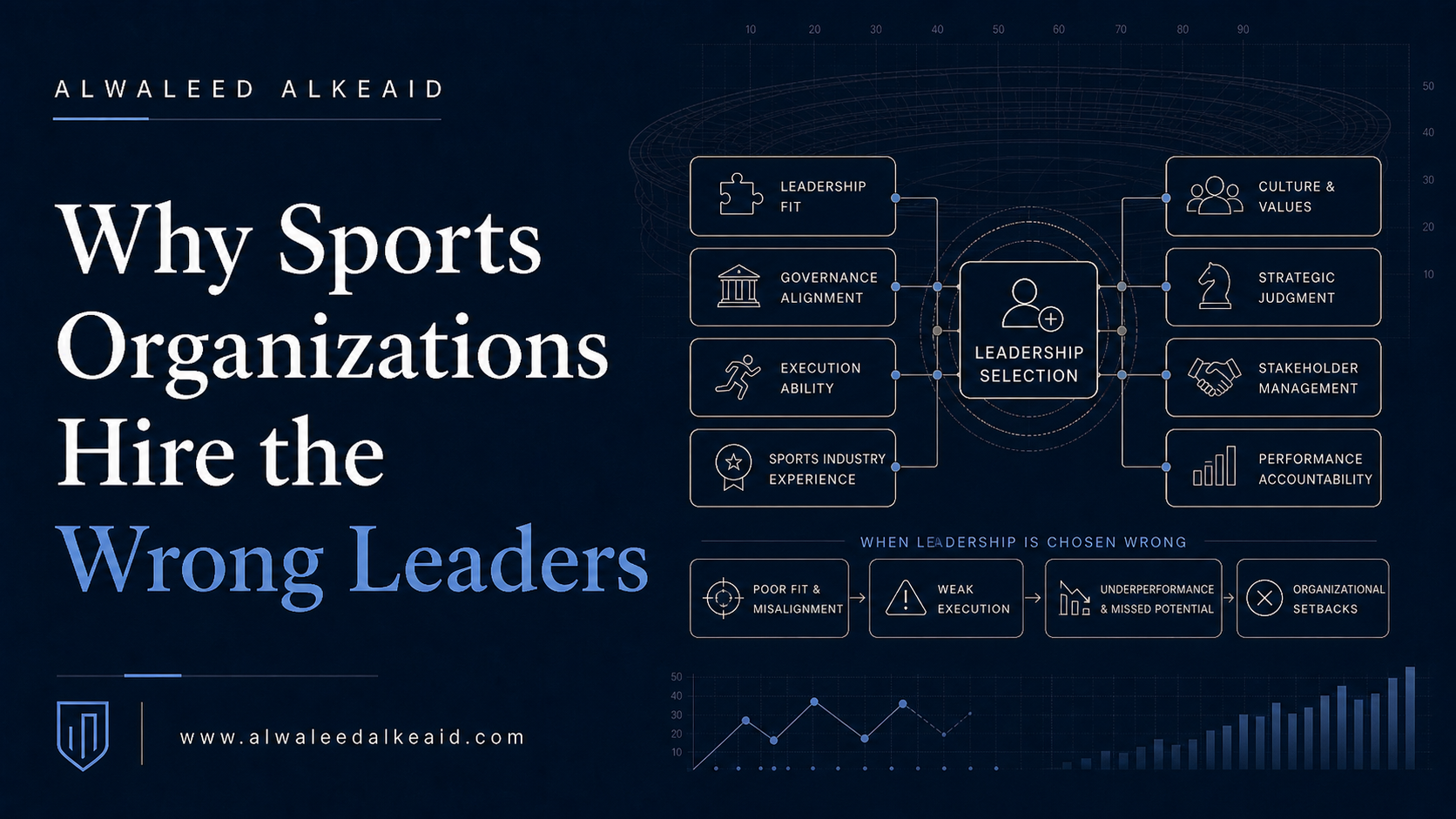
Sports leadership hiring is one of the most important decisions a club, federation, league, academy, event company, or sports organization can make.
The right leader can create structure, build trust, attract talent, improve governance, strengthen commercial performance, and turn strategy into execution.
The wrong leader can do the opposite.
They may look impressive during the interview, speak confidently about transformation, and bring a strong network. Yet after appointment, the organization discovers that the leader cannot manage the board, build a team, control budgets, handle pressure, or turn ideas into results.
That is when the real cost appears.
A bad leadership hire does not only affect one role. It affects staff morale, sponsor confidence, athlete support, board trust, financial discipline, and long-term momentum.
From my experience in sports leadership, federation work, recruitment, and advisory, many organizations do not hire the wrong leader because they are careless. They hire the wrong leader because the process focuses on the wrong signals.
Sport often rewards reputation.
Leadership requires execution.
That difference matters.
Why the wrong leader looks right at first
Many poor leadership appointments make sense at the beginning.
The candidate has worked for a famous club. Another has strong government relationships. Someone else played the sport at a high level. A different candidate delivered one major event or knows influential stakeholders.
These signals can be valuable.
They can also mislead.
A strong background does not automatically mean the candidate can lead your organization. A former athlete may understand performance but struggle with governance. A commercial executive may bring revenue ideas but fail to understand federation politics. An international candidate may have global experience but lack local context.
A person who succeeded in one environment may fail in another.
That is why sports leadership hiring should focus less on status and more on fit.
Fit does not mean choosing someone familiar. It means understanding the organization’s actual challenge and selecting a leader with the capability to solve it.
Mistake 1: Hiring before defining the real problem
Many sports organizations begin recruitment with a title.
CEO. Secretary general. Technical director. Commercial director. Head of performance. Event director.
That is not enough.
Before hiring, leaders must define the real problem.
Does the organization need governance reform?
Is commercial revenue weak?
Do technical pathways need rebuilding?
Are staff underperforming?
Does the board interfere too much?
Are partnerships poorly managed?
Has the organization outgrown its current structure?
Is the priority transformation, stability, growth, or crisis recovery?
Each problem requires a different leader.
A turnaround leader may not be the right person for a growth phase. A commercial builder may not solve governance problems. A technical expert may not know how to manage a complex institution.
When organizations fail to define the problem, they hire based on personality, urgency, or reputation.
That is how the wrong leader gets selected.
Mistake 2: Confusing relationships with leadership
Relationships matter in sport.
A leader who can work with boards, government entities, sponsors, federations, athletes, clubs, media, and international bodies has an advantage.
However, relationships are not the same as leadership.
Some candidates have strong networks but weak operating discipline. They can open doors but cannot build systems. People may like them, yet their teams do not perform. They know everyone but do not follow through.
That creates a dangerous pattern.
The organization hires someone because of who they know, then discovers that the leader cannot execute what the organization needs.
A strong sports leader should have relationships and capability.
Both matter.
One without the other is not enough.
Mistake 3: Overvaluing presentation skills
Some candidates interview extremely well.
They use the right language. Speak about vision. Reference global trends. Share impressive ideas. Tell the board what it wants to hear.
A strong presentation can hide weak execution.
Boards should listen for evidence, not only confidence.
A serious candidate should explain what they inherited in previous roles, what they changed, which systems they built, who they hired, how they handled resistance, and what results they can prove.
Vague answers should raise concern.
Leadership in sport is not only about describing the future. It is about building the path to reach it.
The candidate who speaks less impressively but explains execution clearly may be the stronger choice.
Mistake 4: The board is not ready for the leader it wants
Sometimes the candidate is not the main problem.
The board is.
A board may say it wants a strong CEO but continue managing daily operations. Another board may ask for transformation while refusing to change its own decision-making habits. Some boards hire executives but do not give them authority, budget, or support.
This creates a predictable failure.
The leader becomes accountable for results without the ability to execute properly.
Good governance requires clear role separation between board oversight and executive operations. Sport England’s Code for Sports Governance states that boards should set strategy and maintain a clear division between the board’s management and oversight role and the executive’s operational role. It also requires the chair and CEO roles to remain separate, with the division established in writing.
The principle applies widely.
A board that hires a leader must also create the conditions for that leader to succeed.
If decision rights remain unclear, even the right candidate can fail.
Mistake 5: Hiring for today’s pressure instead of tomorrow’s organization
Urgency often damages sports leadership hiring.
A club loses matches and rushes to hire a new executive. A federation faces criticism and wants a quick fix. A major event is approaching, so leaders appoint someone available rather than someone suitable.
Short-term pressure can force fast decisions.
That does not mean the decision should be shallow.
Sports organizations should ask whether the candidate fits the future, not only the current problem.
Will this leader still be right in three years?
Can they build systems, not only solve immediate issues?
Do they develop people?
Can they handle growth?
Will they improve governance?
Are they capable of building long-term value?
A leader hired only for urgent pressure may not fit the next phase.
That is how organizations keep replacing leaders instead of building continuity.
Mistake 6: Ignoring governance maturity
Sports organizations need leaders who understand governance.
This matters in clubs, federations, leagues, academies, and event entities.
A leader who does not respect governance can create risk quickly. They may bypass policies, personalize decisions, resist reporting, ignore conflicts of interest, or treat the board as an obstacle.
On the other side, a leader who fears governance may become too slow.
The right leader understands how to work inside a governance system.
The IOC’s Basic Universal Principles of Good Governance emphasize accountability, transparency, control, ethical standards, competence, democratic processes, athlete involvement, and strategic direction for sports organizations.
That makes governance maturity a leadership requirement, not a technical detail.
A strong sports leader knows how to make decisions, document them properly, report progress, manage risk, and protect the organization’s credibility.
Mistake 7: Weak due diligence
Many organizations rely too heavily on interviews and references provided by the candidate.
That is not enough.
Leadership hiring requires due diligence.
Boards should verify achievements, understand the candidate’s real contribution, speak to people who worked above, below, and alongside them, and examine how they behaved under pressure.
A candidate’s career story often sounds clean.
Reality is usually more complex.
Did the candidate build the result or inherit it?
Were they the decision-maker or part of a bigger system?
Did their team respect them?
How did they handle conflict?
What happened after they left?
Were there governance or financial concerns?
Can their claimed results be verified?
The goal is not to find a perfect leader.
That person does not exist.
Due diligence helps the board understand the real leader behind the profile.
Mistake 8: Treating culture fit too casually
Culture fit does not mean hiring someone similar to the board.
That can create groupthink.
Real culture fit means the candidate can lead effectively inside the organization’s environment while improving it.
Sport has unique cultures.
A national federation is different from a professional club. A startup sports business differs from a government-linked project. An international rights-holder entering Saudi Arabia will operate differently from a local community club.
A leader must understand the context.
They must know how to communicate, make decisions, manage emotions, respect stakeholders, and build trust.
At the same time, the leader should not simply adapt to bad habits.
The best leaders fit the environment well enough to earn trust and challenge it strongly enough to improve performance.
What sports organizations should look for instead
Sports leadership hiring should focus on capability, fit, and execution.
A strong candidate should show evidence in six areas.
First, they understand governance and can work with a board.
Second, they know how to turn strategy into operating systems.
Commercial awareness also matters, even in nonprofit or federation settings.
Strong people leadership should appear in their track record. They should know how to hire, develop, challenge, and retain teams.
Stakeholder management is another core requirement because sport involves athletes, fans, sponsors, boards, government, media, and communities.
Finally, the candidate must show learning ability. Sport is changing quickly, and leaders who stop learning become a risk.
A strong sports leader does not need to be perfect in every area.
They do need enough range to lead a complex organization.
Better questions to ask before hiring
Boards should improve the questions they ask before recruitment even begins.
What problem are we hiring this person to solve?
Which leadership style does this phase require?
What authority will the leader actually have?
How will success be measured after 90 days, 12 months, and three years?
Which relationships matter most in this role?
What capabilities are non-negotiable?
Where can we compromise?
Do we need a builder, stabilizer, reformer, commercial leader, technical leader, or crisis leader?
These questions make the process sharper.
They also reduce the risk of choosing a candidate who looks attractive but does not match the real mission.
Interview questions that test execution
A strong interview should test judgment, not just personality.
Boards can ask:
What challenge did you face in your last leadership role?
Which situation did you inherit when you arrived?
What issue did you address first?
Who did you bring into the team?
Which systems or processes did you build?
How did you manage resistance from stakeholders?
Which results can you clearly prove?
Looking back, what would you do differently?
These questions force the candidate to move from theory to reality.
A leader who has executed can answer them clearly.
Someone who only speaks in general language will struggle.
Why this matters for Saudi and GCC sport
Saudi Arabia and the wider GCC are entering a more demanding sports era.
Club privatization, federation reform, major events, sports tourism, facility investment, women’s sports, esports, commercial growth, and the 2034 World Cup are increasing the need for stronger leadership.
The region does not only need more people in senior roles.
It needs leaders who can execute inside complex environments.
A CEO, secretary general, technical director, or commercial leader in this market must understand governance, stakeholders, culture, systems, revenue, talent, and international standards.
This is why sports executive recruitment should be strategic, not reactive.
The wrong leader can delay progress for years.
The right one can accelerate an entire organization.
A practical checklist before making an offer
Before hiring a sports leader, boards should ask:
Have we defined the real problem clearly?
Does this candidate match the phase we are entering?
Can they prove execution, not only talk about vision?
Do they understand governance and board dynamics?
Have we checked their real contribution in previous roles?
Can they build teams and systems?
Do they understand our local and stakeholder context?
Will they improve the culture or simply adapt to it?
Have we defined success for the first 90 days?
Are we ready to give them the authority required to deliver?
If the answer to several of these questions is unclear, the organization should slow down.
A rushed senior hire can become one of the most expensive mistakes in sport.
Hire for the problem, not the profile
Sports organizations keep hiring the wrong leaders because they focus too much on the profile and not enough on the problem.
A big name may impress. A strong network may help. A polished interview may create confidence.
None of that guarantees execution.
The best hiring decisions start with clarity.
What does the organization need now?
Which leader can solve that problem?
What authority will they have?
How will the board support and challenge them?
Can they build systems that last beyond their personality?
Sport does not need more leaders who only sound impressive.
It needs leaders who can execute, govern responsibly, build teams, manage complexity, and create sustainable progress.
The right leader does not only fit the role.
They fit the mission.
If your club, federation, league, or sports organization is preparing to hire a CEO, secretary general, technical director, commercial leader, or senior executive, the first step is role and mission clarity.
I work with sports organizations on sports executive recruitment, leadership structures, sports strategy and governance advisory, and hiring systems that help boards choose leaders who can actually execute.