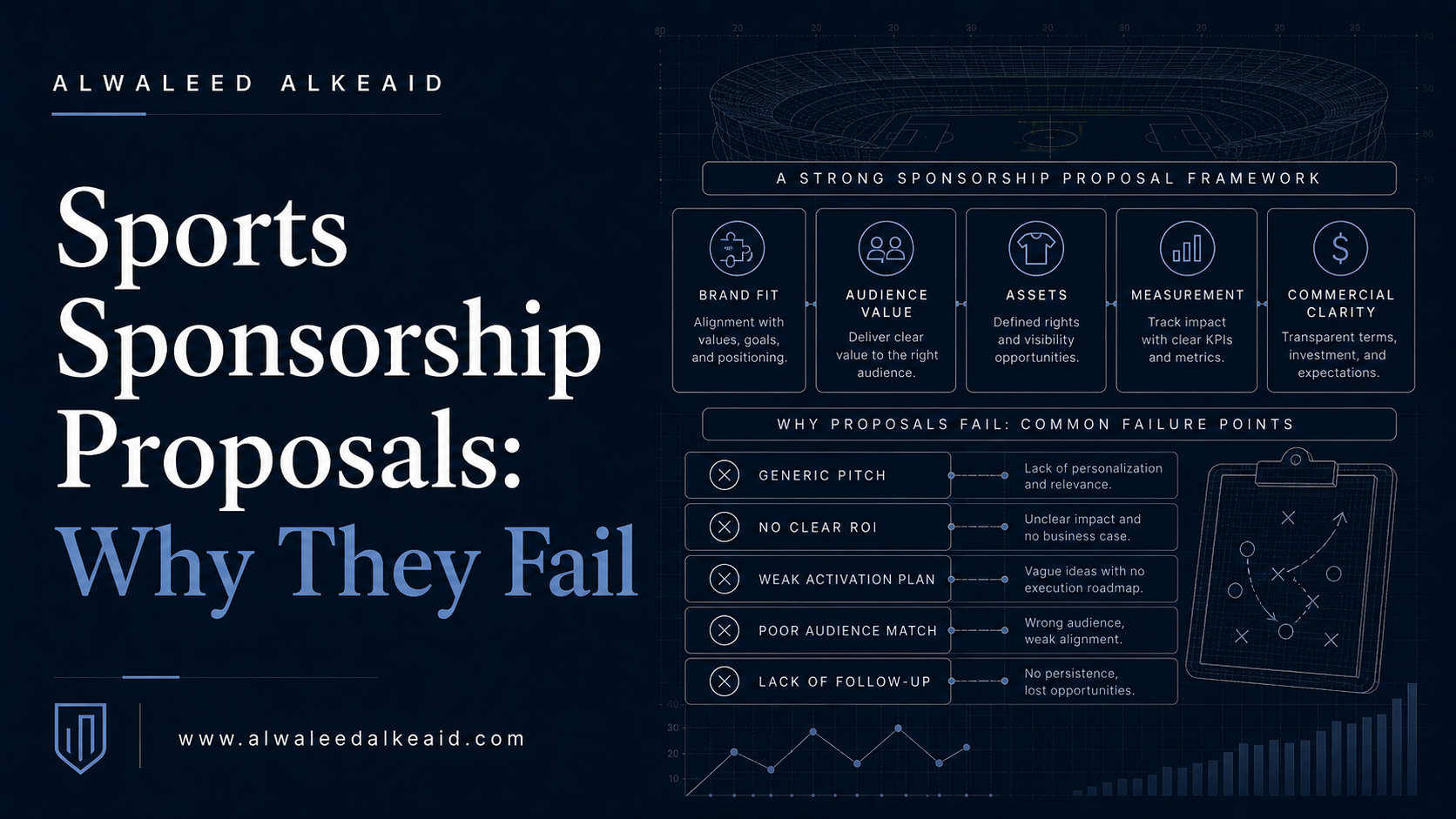
Sports sponsorship proposals often fail before they reach the real decision-maker because they focus on exposure instead of business value.
A club, federation, athlete, or event may have real potential. The audience may be loyal. The story may be strong. Yet the proposal still gets ignored because it does not explain why the sponsor should care, what business problem the partnership solves, or how success will be measured.
That is the sponsorship gap many sports organizations face.
They prepare a deck. Add sponsorship tiers. Include logos, social media numbers, event photos, and a price list. After that, they send it to as many companies as possible and wait for a reply.
Most replies never come.
The problem is not always the sports property. Very often, the problem is the proposal.
Sports sponsorship has changed. Brands are not only buying logo placement. They want audience insight, strategic alignment, content opportunities, measurable outcomes, community impact, and confidence that the organization can deliver. PwC reported that the global sports sponsorship market was expected to grow from $63.1 billion in 2021 to $109.1 billion by 2030, which shows how valuable and competitive this space has become.
That growth creates opportunity.
It also raises the standard.
From my experience in sports leadership, federation work, commercial discussions, and advisory, most sports sponsorship proposals fail because they are written from the seller’s point of view.
They explain what the sports organization wants.
Stronger proposals explain what the sponsor gains.
The real sponsorship problem
The first mistake is assuming that passion is enough.
Sport is emotional. Fans care deeply. Athletes inspire people. Clubs carry identity. Federations represent national development. Events create moments that people remember.
All of that matters.
Still, emotion alone does not secure sponsorship.
A company will usually ask practical questions before committing money:
Who are we reaching?
Why does this audience matter to us?
How will this partnership support our business goals?
What can we activate beyond logo placement?
How will success be measured?
Can this organization deliver professionally?
What risk does this partnership create?
Why should we choose this opportunity instead of another?
Weak sports sponsorship proposals do not answer these questions clearly.
They talk about exposure, but not conversion. Reach appears in the deck, but audience quality stays unclear. Packages are listed, yet activation ideas feel generic. Rights are offered, but the commercial story is missing.
This is why many proposals never reach the senior decision-maker.
Someone in marketing, communications, partnerships, or procurement reviews the deck and sees nothing strong enough to move forward.
Why “gold, silver, bronze” packages are not enough
Many sponsorship decks still follow the same old structure.
Gold sponsor.
Silver sponsor.
Bronze sponsor.
Logo on banner/website/social media
VIP seats.
Mention in press release.
This format may look organized, but it often feels lazy.
Sponsors do not want to feel like they are buying from a menu.
They want to feel like the sports organization understands their business.
A bank, telecom company, airline, real estate developer, healthcare provider, fitness brand, technology company, or government-linked entity will not have the same objectives. Each sponsor has different audiences, messages, risks, priorities, and internal approval processes.
A generic package says, “Here is what we sell.”
A strategic proposal says, “Here is why this partnership makes sense for you.”
That difference matters.
Decision-makers are not buying exposure
Exposure still has value.
It is no longer enough.
Modern sponsors want proof that a partnership can create business, brand, community, or reputation value. Deloitte estimated the global sports sponsorship market at $97 billion in 2025 and highlighted the growing importance of measuring partnership impact and return on investment.
This means sports organizations must think differently.
A sponsor is not only asking, “How many people will see our logo?”
Better questions now include:
Will fans remember the brand?
Can the partnership create content people share?
Does it support our positioning?
Can it help us reach a specific customer segment?
Will it improve loyalty or perception?
Can it generate leads, visits, sales, sign-ups, or community impact?
How will we measure success?
Sports organizations that cannot answer these questions will struggle.
The sponsor may like the sport. They may respect the organization. In some cases, they may even know the leadership personally.
Respect does not always turn into budget approval.
Budget approval needs a business case.
Mistake 1: The proposal starts with the organization
Many sponsorship decks begin with a long introduction about the club, federation, event, or athlete.
That is understandable.
It often misses the point.
The sponsor already knows the organization wants money. What they need to understand is why this opportunity matters to them.
A stronger proposal starts with the sponsor’s world.
What market are they trying to reach?
Which audience do they want to influence?
What brand challenge are they facing?
How can sport help them build trust, visibility, loyalty, or relevance?
Why does this partnership fit now?
Once that context is clear, the sports organization can introduce itself as the right platform.
This shift changes the tone.
Instead of asking for support, the proposal presents a business opportunity.
Mistake 2: The audience is too vague
Sponsors do not only care about audience size.
They care about audience relevance.
A club may say it has thousands of fans. A federation may say it reaches young people. An event may say it attracts families. An athlete may say they have strong social media reach.
Those statements are not enough.
Sponsors want to know who the audience is, where they are, what they care about, how they behave, and how the partnership can reach them meaningfully.
Age, location, gender, spending behavior, digital engagement, attendance patterns, family profile, community connection, and content consumption all matter.
PwC describes digital fan engagement as the “front door to fandom” and points to unified digital ecosystems that connect tickets, streaming, social content, commerce, personalization, and loyalty. That direction shows why audience data has become central to sports commercial strategy.
If a sports organization does not understand its audience, it cannot sell that audience confidently.
Data does not need to be perfect at the beginning.
It does need to be honest, useful, and improving.
Mistake 3: Assets are sold instead of outcomes
A sponsorship asset is something the sponsor receives.
A logo placement.
A booth.
A social media post.
A speaking opportunity.
A VIP invitation.
A naming right.
An outcome is what the sponsor wants to achieve.
More brand awareness.
Stronger community trust.
Customer engagement.
Employee pride.
Lead generation.
Youth impact.
Content creation.
Market entry.
Reputation building.
Too many sports sponsorship proposals stop at assets.
The best proposals connect assets to outcomes.
Instead of saying:
“Your logo will appear on our event backdrop.”
Say:
“This visibility will place your brand inside a family-focused sports event that reaches parents, young athletes, schools, and community leaders. We will support it with short-form content, event photography, sponsor mentions, and post-event reporting.”
That is more valuable because it explains the purpose behind the asset.
Mistake 4: There is no activation plan
Sponsorship without activation is just paid visibility.
Activation brings the partnership to life.
It can include fan challenges, content series, community clinics, athlete appearances, product trials, school programs, VIP experiences, digital campaigns, loyalty rewards, data capture, employee engagement, or hospitality.
A sponsor may buy rights, but activation creates impact.
Many sports organizations leave activation to the sponsor.
That is a mistake.
A rights holder should bring ideas to the table. These ideas do not need to be final, but they should show that the organization understands how to create value beyond the logo.
A strong proposal might include three activation concepts:
One for fan engagement.
Another for community impact.
And one for digital content.
That immediately makes the proposal feel more serious.
Mistake 5: The fee is not justified
Pricing is one of the weakest parts of many sponsorship decks.
Some organizations set prices based on what they want to raise. Others copy prices from another event or club. In some cases, the price has no clear connection to audience size, rights value, activation support, category exclusivity, media reach, or delivery capacity.
That creates doubt.
Sponsors need to understand what they are paying for.
A proposal does not need to reveal every internal calculation. It should still justify the value.
Rights, audience access, content, hospitality, exclusivity, community impact, reporting, and activation support all help explain the fee.
When pricing feels random, the sponsor either negotiates aggressively or walks away.
A strong proposal makes the investment feel logical.
Mistake 6: The organization does not prove delivery
Sponsors evaluate more than the opportunity.
They also evaluate the team behind it.
Can this organization deliver what it promises?
Will the event run professionally?
Can deadlines be met?
Does the team understand brand guidelines?
Will reports be sent after the campaign?
Are there reputational risks?
Can the organization manage VIP guests, media, athletes, and content?
Trust matters.
A proposal should include proof of delivery.
That can include past events, partner testimonials, media coverage, case studies, audience data, photos, operational experience, governance standards, or leadership credentials.
For high-value sponsorships, credibility can decide the outcome.
A sponsor may like the idea. If they do not trust the execution, they will not approve the budget.
Mistake 7: Measurement is missing
Sponsors want to know what success looks like.
Many proposals do not define it.
That creates a problem.
A sports organization may believe the partnership succeeded because the event looked good. The sponsor may judge success differently. They may care about leads, engagement, content views, media mentions, hospitality attendance, customer feedback, or internal stakeholder satisfaction.
A strong proposal should include a simple measurement plan.
Possible metrics include:
Audience reach.
Content performance.
Engagement rate.
Event attendance.
Lead capture.
Media coverage.
Hospitality usage.
Brand mentions.
Community participation.
Post-event survey results.
Sponsor deliverables completed.
The goal is not to overwhelm the sponsor with dashboards.
A clear reporting promise is enough to show professionalism.
Mistake 8: The proposal reaches the wrong person
Even good sports sponsorship proposals can fail when they reach the wrong person.
Sports organizations often send proposals to general emails, junior staff, personal contacts, or people who like sport but do not control budgets.
This wastes time.
A strong sponsorship approach starts with mapping the decision process.
Who
influences the decision?
owns the budget?
evaluates brand fit?
approves legal terms?
manages activation?
signs the final agreement?
In many companies, sponsorship decisions involve marketing, communications, brand, CSR, commercial, procurement, legal, and executive leadership.
That means one email rarely closes the deal.
The proposal must be supported by relationship-building, warm introductions, follow-up conversations, and internal champions.
The goal is not just to send a deck.
It is to move the opportunity through the organization.
What a stronger sports sponsorship proposal should include
A serious sponsorship proposal should feel like a business case, not a donation request.
It should include:
A sponsor-focused opening.
A short explanation of the opportunity.
Audience insight.
Brand alignment.
Partnership objectives.
Rights and benefits.
Activation ideas.
Content and media opportunities.
Community or social impact.
Measurement plan.
Delivery proof.
Investment options.
Clear next step.
The proposal should be easy to read.
Decision-makers do not want long, crowded decks. They want clarity, relevance, and confidence.
A good proposal helps them understand the opportunity quickly.
An excellent proposal helps them explain it internally.
What to fix before asking for money
Before sending sponsorship proposals, sports organizations should prepare properly.
Start by defining the audience. Sponsors need to know who they are reaching.
Then clarify the commercial story. Why does this property matter now?
After that, map the assets. Understand what can be sold, activated, measured, and delivered.
Sponsor categories should come next. Not every brand is a good fit.
Once that is clear, create tailored proposals for priority prospects.
Finally, prepare the follow-up process. Sponsorship gets sold through conversations, not just documents.
This is where sports commercial strategy becomes important.
A proposal is only one part of the system.
Without a strong commercial strategy, even a well-designed deck may fail.
The Saudi and GCC sports sponsorship proposals opportunity
Saudi Arabia and the GCC are entering a more mature sports commercial phase.
Major events, club privatization, facility development, women’s sports, esports, combat sports, football growth, and tourism projects are creating new sponsorship opportunities.
At the same time, brands are becoming more selective.
They want partnerships that connect to national transformation, youth, wellness, entertainment, community, innovation, and measurable engagement.
This creates a major opportunity for clubs, federations, academies, athletes, and event owners.
It also raises the standard.
A generic sponsorship proposal will not be enough in a market that is becoming more professional.
Sports organizations need to move from asking for sponsorship to building partnerships.
That shift requires better data, better storytelling, better activation, and better reporting.
Sports sponsorship propsals practical checklist before sending
Before sending a sponsorship proposal, ask:
Does the first page explain why this matters to the sponsor?
Have we shown audience quality, not only audience size?
Does the proposal connect assets to outcomes?
Are activation ideas included?
Can we justify the fee?
Have we proved we can deliver?
Is there a simple measurement plan?
Are we sending it to the right person?
Can the recipient explain this opportunity internally?
Does the proposal feel like a partnership, not a request?
These questions may sound basic.
Most failed proposals ignore at least half of them.
Sponsors fund value, not need
Most sports sponsorship proposals fail because they are built around the needs of the sports organization.
Sponsors think differently.
They want value, alignment, credibility, engagement, measurement, and confidence.
A club may need funding. A federation may need support. An athlete may need backing. An event may need partners.
Those needs are real.
But sponsors do not fund need.
They fund value.
The sports organizations that understand this will build stronger partnerships, attract better sponsors, and create more sustainable commercial growth.
Those that keep selling logos and generic packages will keep wondering why decision-makers do not respond.
Sponsorship is not just about being visible.
It is about being valuable.
If your club, federation, sports organization, or event company is trying to attract stronger sponsors, the first step is not sending more proposals.
It is building a clearer commercial strategy, stronger audience story, better activation model, and a sponsorship offer that decision-makers can believe in.
I work with sports leaders and organizations on sports commercial strategy, sports strategy and governance advisory, sponsorship positioning, and partnership systems that help turn attention into sustainable value.