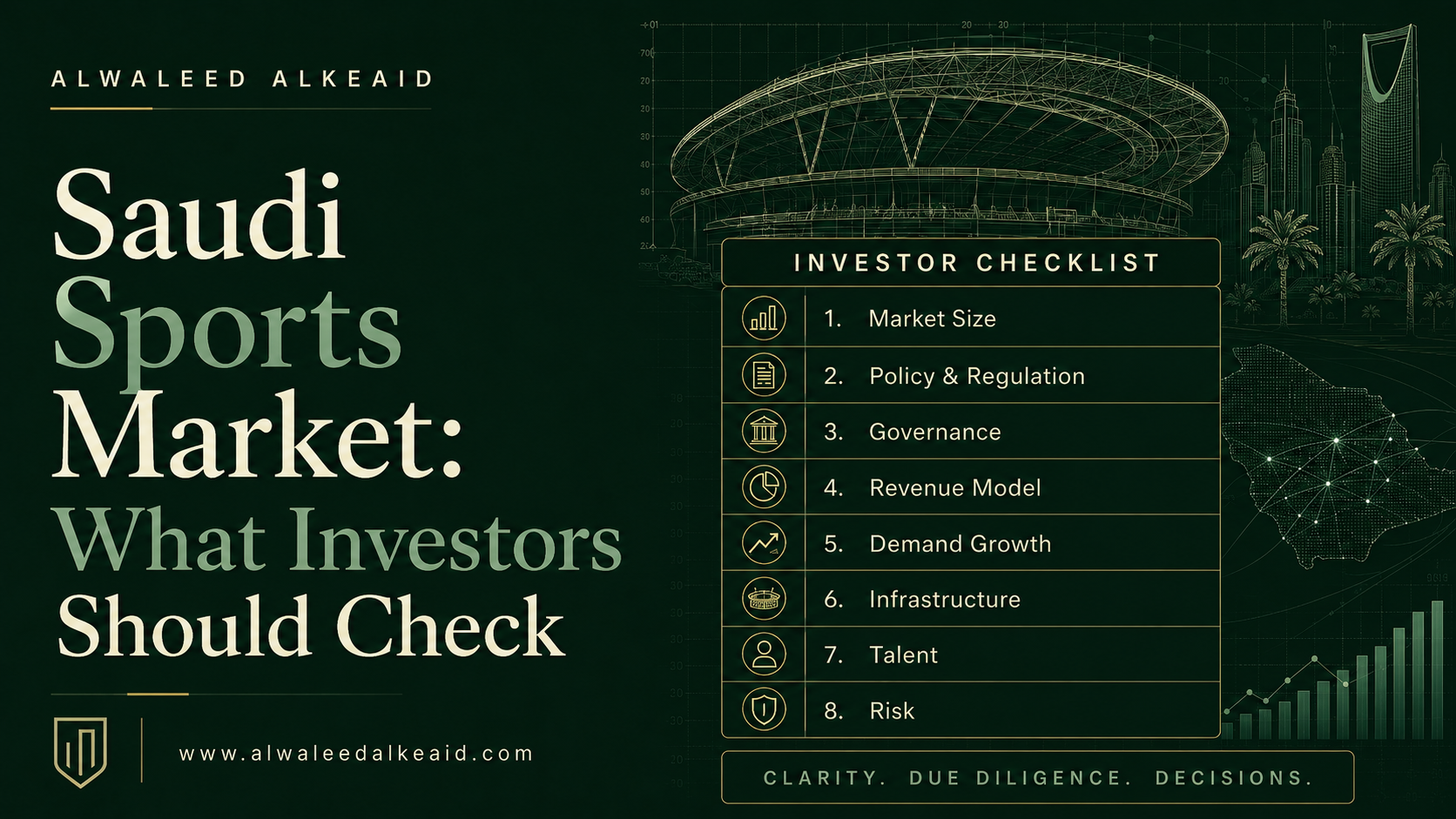
The Saudi sports market is attracting increasing attention from investors, international companies, operators, rights holders, and sports businesses.
That interest is understandable.
Saudi Arabia is opening more of its sports ecosystem to private-sector participation. The Ministry of Sport identifies 12 priority investment directions, including sports clubs, academies, facilities, events, sports technology and data, sports tourism, sponsorship, talent development, and sports programs.
Club ownership is also evolving. In July 2025, Al-Ansar, Al-Kholood, and Al-Zulfi became the first three clubs privatized through the Ministry of Sport’s public offering process.
Then, in April 2026, PIF and Kingdom Holding Company signed an agreement for KHC to acquire 70% of Al-Hilal Club Company, based on an enterprise value of SAR 1.4 billion for the club’s total share capital, subject to regulatory approvals and other completion conditions.
These developments show a market moving toward greater commercialization and private participation.
But growth does not remove risk.
Investors should not enter Saudi sport simply because the sector is expanding.
They should understand exactly what they are investing in, how value will be created, who controls the important decisions, and whether the opportunity can become commercially sustainable.
Start with the opportunity, not the excitement
Saudi sport has momentum.
That does not mean every sports asset is equally attractive.
An investor looking at a club, academy, venue, event company, technology platform, sports tourism business, or service provider should first identify the real investment thesis.
Where will value come from?
Revenue growth?
Asset appreciation?
Media rights?
Sponsorship?
Membership?
Participation?
Venue utilization?
Hospitality?
Technology adoption?
Government contracts?
Market consolidation?
International expansion?
Without a clear answer, the investor may simply be buying exposure to a growing sector rather than investing in a strong business.
Those are not the same thing.
A compelling sports story can attract attention.
An investment still needs an economic logic.
Understand what rights you are actually buying
This is one of the first areas investors should investigate.
Sports assets are built around rights.
A club may control some commercial assets but not others. A venue operator may manage the facility without controlling every event held inside it. A federation may own competition rights while another entity manages broadcasting or commercial activation.
Investors need a clear rights map.
That includes brand rights, sponsorship inventory, media rights, ticketing, hospitality, merchandise, naming rights, intellectual property, data, digital content, academy operations, venue use, and event commercialization.
Do not assume control simply because an organization appears to own the sports property.
Ask who owns each commercial right.
Then determine whether those rights can actually generate revenue.
A valuable audience with weak commercial control may be less attractive than a smaller property with clear and exploitable rights.
Check the governance before the financial model
Investors naturally examine revenue, costs, assets, liabilities, and forecasts.
They should examine governance just as carefully.
Who makes decisions?
What authority does management have?
How is the board structured?
Who approves budgets?
Can the investor appoint directors?
Which decisions require shareholder approval?
How are related-party transactions handled?
What reporting will investors receive?
Who controls senior executive appointments?
What happens when shareholders disagree?
Governance becomes especially important when an organization is moving from a historically institutional or publicly supported model toward a commercially driven one.
Transformation takes more than capital.
The organization may need new systems, clearer decision rights, stronger management, better financial controls, and different commercial capabilities.
PIF specifically highlighted improvements in governance, operations, infrastructure, sponsorship, merchandise, and matchday revenue when describing Al-Hilal’s transformation before its 2026 transaction with Kingdom Holding Company.
That is an important signal.
Investors should not look only at the sports asset they are buying.
They should look at the institution behind it.
Test the commercial model properly
Sports organizations can overestimate commercial potential.
Large audiences do not automatically create large profits.
A famous club can still have weak monetization.
A new venue may look impressive but struggle to maintain year-round utilization.
An academy can attract participants yet operate with poor margins.
An event can sell tickets and still lose money.
Investors need to understand every major revenue stream and test whether it is realistic.
For clubs, that may include sponsorship, matchday revenue, hospitality, merchandise, memberships, academies, content, licensing, and media-related income.
Facilities may depend on events, food and beverage, hospitality, corporate bookings, community use, naming rights, retail, memberships, and non-sports programming.
Technology businesses require a different test: customer acquisition, recurring revenue, procurement cycles, integration costs, retention, and the ability to scale beyond a small group of flagship clients.
The important question is not:
How much revenue could this asset generate?
It is:
What needs to happen operationally for that revenue to become real?
Do not confuse national growth with company-level demand
A sector can grow quickly while individual companies struggle.
That distinction matters.
Saudi Arabia’s sports ecosystem is expanding, but investors still need to prove demand for the specific product or service they are backing.
A sports technology company may see thousands of potential organizations but discover that procurement cycles are long.
An international consultancy may see many projects but find that relationships and local delivery capability determine who wins the work.
A training provider may see workforce demand yet struggle if organizations prefer internal programs or government-funded initiatives.
Market size matters.
Accessible market matters more.
Investors should understand who pays, how decisions are made, how long sales take, what procurement requires, and why customers would choose this company instead of an alternative.
Understand the regulatory route
International investors also need to understand how they will legally operate in Saudi Arabia.
Under Saudi Arabia’s updated Investment Law, foreign investors must register with the Ministry of Investment before beginning investment activity, except for investments in securities governed by the Capital Market Law. Investors may then need commercial registration and approvals, licenses, or permits from the relevant authorities depending on the activity.
Sports activities can also involve sector-specific requirements.
An investor should therefore identify the regulatory route early rather than treating compliance as something to solve after the commercial agreement.
The structure may differ depending on whether the investment involves ownership, operations, facilities, events, professional services, technology, or another activity.
Good local legal, tax, and regulatory advice should form part of the entry process.
The commercial opportunity may be attractive.
The operating structure still needs to work.
Local execution capability matters
International experience is valuable in Saudi sport.
Local understanding is equally important.
Investors should ask who will actually execute the strategy in the Kingdom.
Does the management team understand the Saudi sports ecosystem?
Can it work effectively with clubs, federations, ministries, sponsors, suppliers, government-linked entities, and local communities?
Does the company have strong Arabic and English capability where required?
Can it recruit the right people?
Does leadership understand local decision-making and stakeholder expectations?
Many international companies make the mistake of assuming that success in another sports market will transfer directly.
Saudi Arabia does not need copied models.
It needs models adapted to the local environment.
The strongest international investors will combine global capability with Saudi market understanding.
Talent should be part of the investment thesis
Capital cannot operate a sports business.
People do.
An investor may acquire an attractive asset and then discover that the leadership team cannot deliver the growth plan.
This is particularly important in a sector expanding across clubs, federations, venues, events, technology, academies, commercial operations, and major projects.
Investors should review the leadership team as seriously as the financial statements.
Does the organization have the CEO it needs for the next phase?
Who leads commercial growth?
Is financial leadership strong?
Can operations scale?
Does the organization have specialists in technology, fan engagement, performance, partnerships, venues, or events where required?
Which roles will become critical after investment?
A sports investment plan without a workforce plan is incomplete.
The investor should know which capabilities already exist and which ones must be built.
Understand dependency risk
Another important question is:
What is this business dependent on?
One sponsor?
One government contract?
One major event?
One customer?
One individual relationship?
One funding source?
One star athlete?
One venue?
Concentration can create hidden risk.
A sports business may appear successful because one large contract supports most of its revenue. Another may rely heavily on public funding or one sponsorship relationship.
Investors should separate structural performance from temporary advantage.
Ask what happens if the biggest customer leaves.
What if public funding changes?
How strong is recurring revenue?
Could the business survive a weaker season?
Does the commercial model work without continued exceptional spending?
Growth is valuable.
Resilience matters too.
Look beyond football
Football receives enormous attention in Saudi Arabia, but investors should not assume that the Saudi sports opportunity begins and ends there.
The Ministry of Sport’s priority investment directions cover a much broader ecosystem, including academies, indoor and outdoor facilities, gyms, events, sports technology and data, equipment, tourism, talent development, sponsorship, and sports programs.
Different opportunities carry different risk profiles.
An investor may find stronger economics in participation, technology, facilities, wellness, events, education, or sports services than in acquiring a high-profile club.
The best opportunity may not be the most visible one.
Investors should follow value, not headlines.
Know the exit before entering
Sports investment can become emotional.
Investors still need an exit logic.
Who could buy the asset later?
Could another strategic investor enter?
Can the company generate dividends?
Is there potential for consolidation?
Could the business expand across the GCC?
Would the asset become attractive to institutional capital?
How dependent is valuation on continued sector growth?
The 2026 agreement involving Al-Hilal provides a useful example of capital rotation within the evolving sports market. PIF stated that the proposed sale aligns with its strategy to maximize returns and redeploy capital while continuing to support the club as a shareholder.
Not every sports investment will follow the same path.
But every investor should understand how value eventually returns to shareholders.
Entering is only half of the investment decision.
A practical investor checklist
Before entering the Saudi sports market, investors should be able to answer these questions:
What is the real investment thesis?
Which rights does the asset control?
Where does revenue come from today?
Which revenue streams can realistically grow?
How strong is governance?
Who controls major decisions?
Does management have the capability to execute?
How dependent is the business on public funding, one sponsor, or a small number of customers?
What regulatory approvals or registrations are required?
Does the business understand the Saudi market?
Which talent gaps must be filled?
Can the business operate sustainably without extraordinary market conditions?
What makes the asset difficult to replicate?
What does success look like in five years?
How does the investor eventually realize value?
If several answers remain unclear, more due diligence is needed.
The opportunity is real, but discipline matters
Saudi Arabia continues to create more ways for private capital to participate in sport. The Ministry of Sport held a dedicated meeting with local and international investors in January 2026 as part of its continuing Sports Clubs Investment and Privatization Project, demonstrating the sector’s ongoing effort to attract investment and deepen private participation.
The direction is clear.
But investors should resist the temptation to treat sector momentum as a substitute for due diligence.
Saudi sport can offer compelling opportunities in clubs, infrastructure, events, technology, tourism, participation, talent, and services.
Some will create significant value.
Others may struggle despite operating inside a growing market.
The difference will often come down to fundamentals.
Rights.
Governance.
Management.
Demand.
Commercial discipline.
Execution.
And the ability to build something sustainable after the initial excitement fades.
The question investors should ask is not simply:
“How do we enter the Saudi sports market?”
A better question is:
“Where can we create sustainable value in the Saudi sports market, and what must be true for that investment to succeed?”
That is the question worth answering before the capital goes in.
Work With Me
I advise sports organizations, leaders, investors, and international companies on the Saudi and GCC sports environment, including strategy, governance, operating models, organizational development, talent, and market understanding.
If you are exploring the Saudi sports sector and believe my experience can support your organization, visit the Work With Me section of my website.