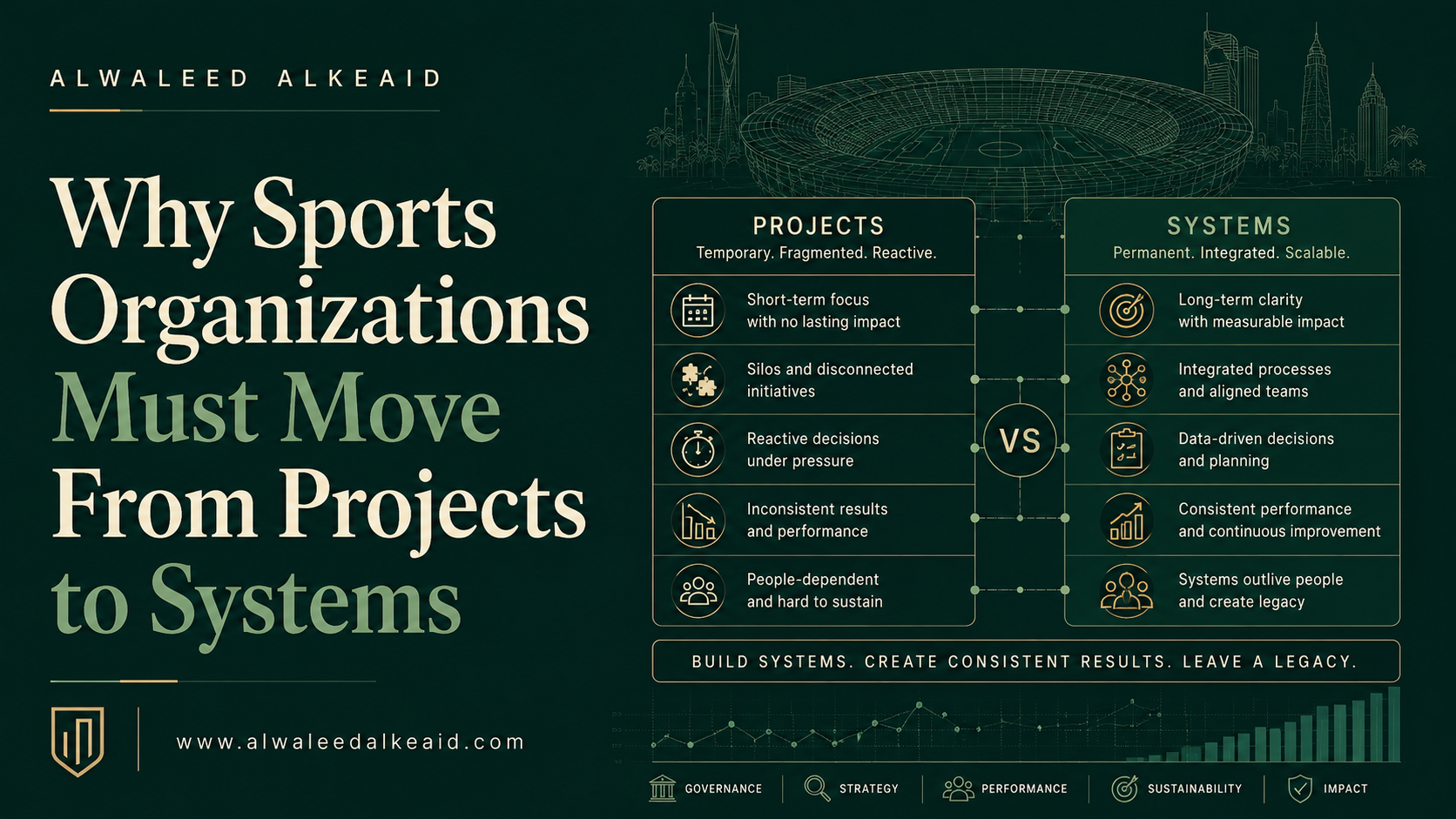
Sports organizations deliver projects constantly.
A new strategy.
A major event.
A sponsorship campaign.
A talent development initiative.
A digital platform.
A governance review.
A recruitment project.
A community program.
Some of these projects succeed.
The problem is what happens next.
The consultant leaves. The event finishes. Leadership changes. The presentation gets archived. Staff return to their normal responsibilities, and six months later the organization begins solving the same problem again.
This is why sports operating systems matter.
Strong sports institutions do not depend on constantly launching new projects. They build systems that allow good work to continue, improve, and produce results repeatedly.
Projects can create change.
Systems make change last.
Projects are not the problem
Sports organizations need projects.
A new stadium requires a project. Hosting a championship requires one. Implementing new technology, restructuring a department, launching an academy, or developing a strategy may all begin as projects.
The mistake is treating work that should become permanent capability as something temporary.
Consider recruitment.
An organization may launch a recruitment project every time someone resigns. It creates the job description, searches for candidates, conducts interviews, appoints someone, and closes the process.
Then another employee leaves.
Everything starts again.
A stronger organization builds a talent system.
Roles have clear profiles. Succession risks get reviewed. Candidate pipelines exist before vacancies appear. Performance data identifies future leaders. Recruitment follows consistent standards. Onboarding connects directly to performance expectations.
Recruitment still contains individual projects.
But a system sits behind them.
That distinction changes the organization.
The project mentality creates repeated problems
Project-driven organizations often look busy.
There are meetings, presentations, consultants, initiatives, workshops, events, and launch announcements.
Activity creates the appearance of progress.
Yet the same problems keep returning.
Why?
Because completing a project is different from changing how the organization operates.
A governance consultant can design new policies. If nobody owns them afterward, behavior does not change.
A commercial advisor can develop a sponsorship strategy. Without a sales process, customer data, ownership, reporting, and follow-up cadence, the strategy remains a document.
An event team can deliver an excellent tournament. If lessons disappear after the closing ceremony, the organization starts almost from zero at the next event.
A federation can launch a coach development program. Without standards, progression pathways, assessment, data, and recurring delivery, it remains an initiative rather than a development system.
The organization keeps buying solutions instead of building capability.
That becomes expensive.
Systems reduce dependence on individuals
Many sports organizations depend heavily on specific people.
One executive knows every sponsor.
One employee understands all the federation procedures.
A technical director carries the entire athlete development model in their head.
One board member has the important relationships.
A project manager knows how the major event actually operates.
Then someone leaves.
Suddenly, the organization discovers how much institutional knowledge walked out with them.
A system reduces this risk.
It does not make people less important.
It makes their knowledge more valuable because the organization captures, shares, and improves it.
Processes become documented.
Responsibilities become clear.
Data sits in accessible systems.
Decisions follow agreed rules.
Teams know what happens next.
Success becomes less dependent on memory, personality, and informal relationships.
That is institutional maturity.
A system has an owner
One of the simplest differences between a project and a system is ownership.
Projects normally have project managers.
Systems need permanent owners.
Someone must remain responsible after launch.
Take athlete development.
A federation may create a national talent identification project.
The project finds athletes, produces reports, and ends.
But who owns talent identification the following year?
Who tracks the athletes?
Who monitors progression?
Who connects clubs, coaches, competitions, performance testing, and national teams?
Who evaluates whether the identification criteria actually work?
Without an owner, the project produces activity.
With ownership, it can become a talent pathway.
Every important institutional system needs someone accountable for keeping it alive.
A system needs a repeatable process
Good organizations should not need to redesign basic work every time it happens.
Board reporting should follow a rhythm.
Executive performance reviews should use agreed criteria.
Sponsor relationships should have a pipeline and account management process.
Recruitment should follow defined stages.
Events should use reusable operating standards.
Financial reviews should happen on schedule.
Athlete progression should follow clear pathways.
Risk should receive regular attention.
Stakeholder communication should not depend on whether someone remembers to send an update.
Repeatability does not mean bureaucracy.
It creates reliability.
People spend less time deciding how work should happen and more time improving the work itself.
A system needs data
Without information, organizations operate on opinion.
A sports organization may believe participation is growing.
Which sports?
Which age groups?
Which regions?
How many participants return?
A club may believe its sponsors are satisfied.
What does renewal data show?
A federation may believe its national pathway works.
How many athletes progress from development programs into elite competition?
Leaders may believe recruitment is effective.
How long does hiring take? Which roles experience the highest turnover? Where are the future leadership gaps?
Systems create information because activity follows a consistent process.
That data helps leaders see patterns.
Once leaders can see patterns, they can make better decisions.
Data should not exist only for annual reports.
It should help the organization operate.
A system needs a management rhythm
Many strategies fail because organizations discuss them once a year.
Strong institutions create a rhythm around performance.
What are we trying to achieve?
What happened this month?
Where are we behind?
Why?
Who owns the problem?
What decision needs to happen?
What changes before the next review?
This rhythm might include weekly operational meetings, monthly performance reviews, quarterly strategic reviews, annual board evaluations, or other structures appropriate to the organization.
The exact calendar matters less than consistency.
Without a review rhythm, problems remain invisible until they become urgent.
Then organizations create another project to fix them.
Systems identify problems earlier.
From sponsorship projects to commercial systems
Commercial development provides a good example.
A sports organization decides it needs more sponsors.
It creates a sponsorship deck.
Staff contact several companies.
Meetings happen.
Perhaps one partnership gets signed.
Then activity slows.
That is a sponsorship project.
A commercial system works differently.
The organization understands its audience.
It maps its assets.
Sponsor categories have clear logic.
A pipeline tracks prospects.
Teams know who owns each relationship.
Proposals reflect sponsor objectives.
Activation gets planned from the beginning.
Partnership performance gets measured.
Renewal discussions start before contracts expire.
Commercial intelligence improves after every conversation.
Individual sponsorship deals still matter.
But the organization no longer starts from zero each time.
That is how commercial capability grows.
From events to event systems
The same principle applies to events.
Sports organizations often become extremely capable during the final weeks before a major competition.
Temporary teams expand.
Consultants arrive.
Problems get solved quickly.
Everyone works longer hours.
The event succeeds.
Then the structure disappears.
A better model turns event delivery into institutional knowledge.
What worked?
What failed?
Which suppliers performed?
What did athletes report?
Where did spectators struggle?
Which operational risks appeared?
How accurate was the budget?
Which staff members showed leadership potential?
What should become standard for the next event?
Every event should leave the organization more capable of delivering the next one.
Otherwise, experience keeps disappearing.
Governance should also operate as a system
Governance is sometimes treated as a compliance project.
Organizations update policies, approve committee terms, review bylaws, and complete governance assessments.
Then attention moves elsewhere.
Governance should operate continuously.
Boards need regular information.
Committees need clear mandates.
Conflicts of interest need processes.
Risk registers need updates.
Executives need defined authority.
Board performance needs review.
Financial controls need consistent application.
Decisions need documentation.
Saudi Arabia’s Ministry of Sport has increasingly connected club development with governance, performance, financial sustainability, facility development, and digital transformation. Its 2025 Club Support Strategy used a performance-based model and described governance and administrative classification as central to efficiency, transparency, accountability, and decision quality.
The direction matters.
Sustainable performance requires an operating environment that continues beyond individual initiatives.
Financial sustainability needs systems too
Financial problems rarely appear overnight.
They develop through repeated decisions.
Poor budgeting.
Weak cost controls.
Delayed reporting.
Unmanaged commitments.
Unrealistic revenue assumptions.
A financial sustainability project can diagnose the problem.
A financial management system prevents the organization from returning to the same position.
Saudi Arabia’s Ministry of Sport has also introduced measures aimed at strengthening financial oversight and club financial performance, including budget monitoring, expenditure control, and more structured financial governance.
That is the difference between intervention and institutionalization.
An intervention fixes something.
Institutionalization changes how the organization works.
Why organizations stay trapped in project mode
There are understandable reasons.
Projects are visible.
They have beginnings and endings.
Budgets can be approved.
Consultants can be hired.
Launches can be announced.
Boards can see deliverables.
Systems are less dramatic.
Nobody celebrates the tenth consecutive month of accurate management reporting.
A reliable recruitment process does not create a launch event.
Maintaining a risk register is not exciting.
Documenting operational knowledge rarely generates headlines.
Yet these less visible activities often determine whether the organization performs consistently.
Institution building is rarely glamorous.
It is extremely valuable.
The consultant should leave capability behind
External expertise can accelerate progress.
Sports organizations should use consultants, advisors, technology providers, recruiters, and specialists when they add expertise that does not exist internally.
The question should be what remains after the assignment.
A strategy project should leave a strategy management process.
A governance review should leave better decision-making.
A recruitment assignment should improve talent intelligence.
An event consultancy should transfer operational knowledge.
A technology implementation should improve how people work, not simply install software.
A commercial project should strengthen the organization’s ability to sell and manage partnerships.
The best external support reduces future dependency.
It should make the organization stronger after the engagement ends.
How to move from projects to systems
Sports organizations do not need to turn everything into a complicated process.
Start with recurring problems.
If the same issue appears repeatedly, it probably needs a system.
Then ask:
What outcome must happen repeatedly?
Define the result before designing the process.
Next, identify ownership.
One person or function must remain accountable.
Map the basic workflow.
What triggers the process? What happens next? Who decides? Where does information go?
Clarify decision rights.
People should understand what they can approve and when escalation is necessary.
Create simple standards.
Templates, checklists, policies, dashboards, and procedures can improve consistency.
Measure the important outcomes.
Do not build reporting for its own sake.
Review performance regularly.
A system should improve as the organization learns.
Finally, preserve knowledge.
Lessons should become part of the next cycle rather than disappearing into old files.
That is how a project becomes capability.
Five systems every sports organization should strengthen
The exact model depends on the organization, but most clubs, federations, leagues, events, and sports companies should have strong systems around at least five areas.
1. Governance and decision-making
Clear authority, reporting, risk management, board oversight, and accountability.
2. Talent and workforce
Workforce planning, recruitment, succession, onboarding, performance, and development.
3. Commercial development
Audience intelligence, asset management, sales pipelines, partnerships, activation, and renewal.
4. Performance and delivery
Strategic priorities, operational planning, KPIs, reviews, and corrective action.
5. Knowledge and data
Reliable information, institutional memory, documentation, learning, and decision support.
These systems connect.
Weakness in one eventually affects the others.
A practical test for leaders
Look at the organization’s most important activities and ask:
If the person responsible left tomorrow, would the work continue?
If leadership changed, would the process survive?
Do we know who owns it?
Is there a repeatable method?
Can we measure whether it works?
Do lessons improve the next cycle?
Can staff explain how decisions happen?
Does information sit inside the organization rather than inside someone’s head?
Are we improving the system, or repeatedly creating projects around the same problem?
The answers reveal how institutionalized the organization really is.
Saudi sport needs institutional capability
Saudi sport continues to expand across clubs, investment, facilities, participation, events, talent, and commercial activity. The Ministry of Sport describes its sector direction around stronger governance and sustainable foundations, while its investment priorities explicitly emphasize building a sustainable sports sector.
The next stage requires more than successful initiatives.
Growth increases complexity.
More investment requires stronger governance.
More events require deeper operating capability.
More clubs and competitions require better talent systems.
Greater commercial ambition requires professional sales and partnership management.
Larger organizations need stronger information and decision-making.
Projects can accelerate development.
Systems allow institutions to absorb that development.
That distinction will become increasingly important.
Conclusion: build something that continues
Sports organizations should still launch projects.
They should still hire specialists, develop new strategies, host events, introduce technology, and experiment with new ideas.
But every important project should raise one additional question:
What should become permanent after this project ends?
Perhaps it is a process.
A new capability.
A dataset.
A management rhythm.
A stronger team.
A governance mechanism.
A commercial model.
A standard.
A lesson that changes how future work gets done.
The strongest sports organizations do not simply complete more projects.
They become better at repeatedly producing results.
Projects create outputs.
Systems create institutions.
And institutions are what allow sporting ambition to survive changes in leadership, funding, people, and circumstances.
That is the real objective.
Work With Me
I work with sports organizations and leaders on strategy, governance, operating models, institutional performance, organizational development, and talent.
If your organization has strong ambitions but finds itself repeatedly solving the same operational problems, the answer may not be another project.
It may be a stronger system.