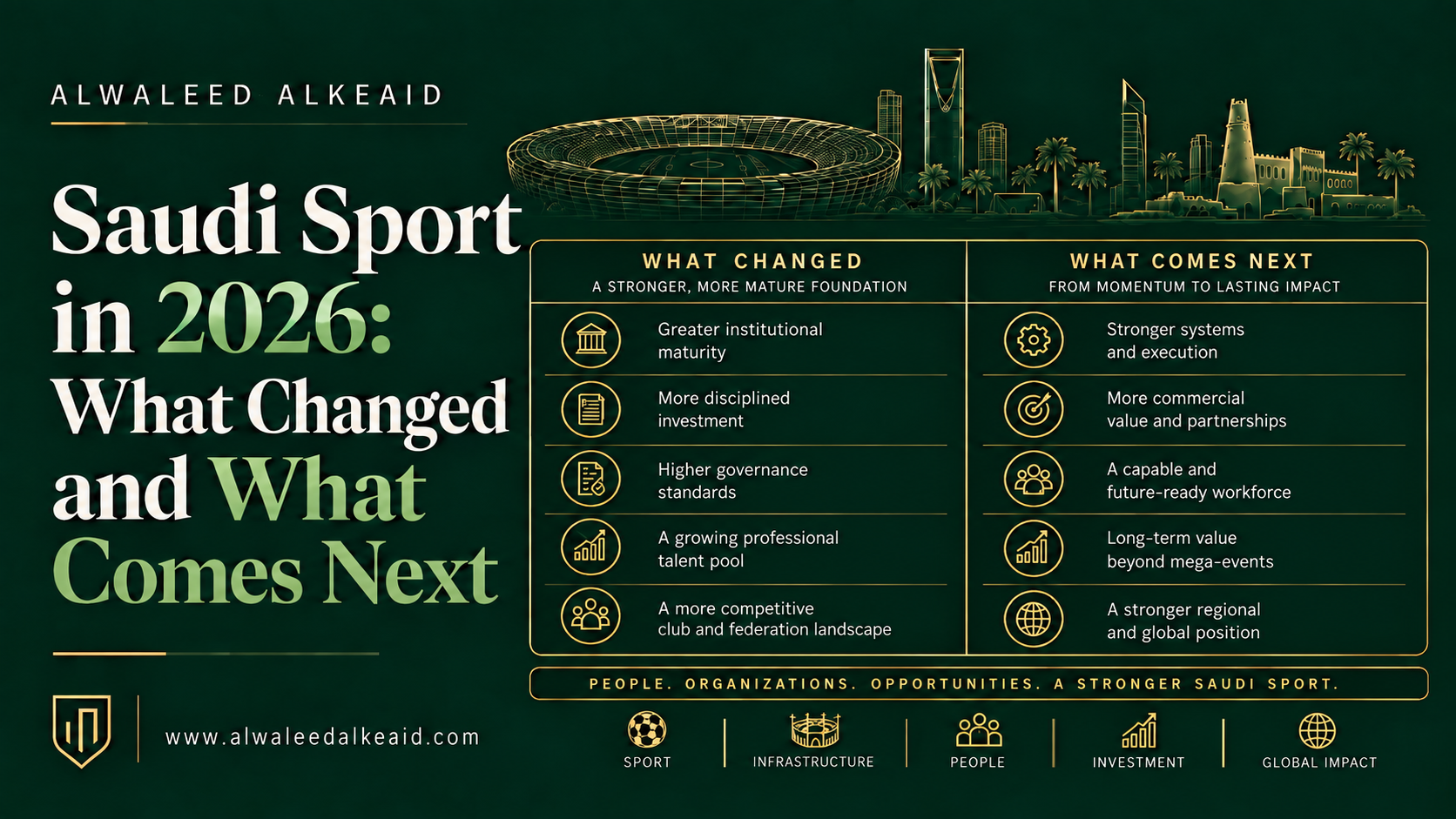
Saudi sport in 2026 looks different from the sector we were discussing only a few years ago.
The transformation is no longer mainly about attracting major events, signing international athletes, or demonstrating ambition. Those things still matter, but the conversation is changing.
A Sports Law is now in force. Club privatization is progressing. Major facilities are moving toward new operating models. Private capital has a clearer role. Preparation for the 2034 FIFA World Cup is increasingly becoming a delivery challenge rather than a future concept.
The harder question now is whether Saudi sports institutions can operate, commercialize, govern, and sustain everything being built around them.
That, in my view, is where the next phase begins.
The sector is becoming an industry
Saudi sport is now much broader than professional football and major events.
MISA’s investment material estimated the Saudi sports market at approximately SAR 32 billion in 2024 across 17 subsectors, with a National Sports Strategy target of around SAR 85 billion by 2030. The market includes facilities, operations, clubs, leagues, tourism, technology, data, coaching, equipment, sports medicine, agencies and professional services.
Private investment had also accelerated before 2026. MISA’s figures show annual private-sector sports investment inflows rising from approximately SAR 0.22 billion in 2022 to SAR 1.84 billion in 2024. Its investment work identifies opportunities ranging from academies and facilities to data analytics, talent management, sports tourism and event management.
The important point is not one forecast.
It is the structure of the market.
Saudi sport is becoming a value chain, and a value chain requires institutions capable of managing investment, people, data, assets, commercial rights and operations.
Regulation became more serious in 2026
One of the year’s most important developments received less public attention than many sporting announcements.
Saudi Arabia’s Sports Law entered into force on 11 June 2026. It establishes a broad framework covering federations, leagues, clubs, athletes, coaches, sports facilities, academies, competitions, professional licensing and other parts of the sector. The Ministry states that the law is intended to strengthen governance and institutional performance while supporting participation and investment.
That is an important step.
But regulation alone does not create strong institutions.
A federation can have approved policies and still operate with unclear authority. A club can have a governance structure while management lacks the decision rights needed to execute. Committees can exist without adding much value.
The next stage of governance should therefore be judged less by the existence of frameworks and more by whether those frameworks improve how organizations actually work.
Governance becomes valuable when it produces better decisions.
Privatization moved from policy toward a real market
Club privatization continued to develop during 2026.
In June, Al-Riyadh, Abha, Al-Fateh, Al-Tai and Al-Shoulla were offered to investors. The Ministry also reported more than 80 expressions of interest involving 22 clubs.
That is encouraging, but the headline requires context.
Interest is not investment. Prequalification is not ownership. Ownership is not transformation.
The stronger measure will be the number and quality of completed transactions, followed by what happens inside those clubs after ownership changes.
Privatization should eventually produce stronger management, clearer governance, better commercial performance, greater financial discipline and more sustainable organizations.
Al-Hilal provides an important development in this conversation.
On 1 September 2026, Kingdom Holding Company completed its acquisition of 70% of Al-Hilal Club Company from PIF for SAR 840 million. PIF retains the remaining 30%. The transaction was completed after all required approvals and conditions were satisfied.
The transaction provides an important valuation signal for Saudi sport.
But I would not yet call it a broad market benchmark for Saudi club valuations.
One transaction involving one of the Kingdom’s strongest sports brands cannot tell us how the wider club market should be priced. A more meaningful benchmark will emerge as more clubs complete transactions across different ownership profiles, sporting levels, commercial models and investor types.
That is when the market will begin to reveal what different Saudi sports assets are actually worth.
Facilities are moving from construction toward operations
Another important shift is happening around sports infrastructure.
For years, the obvious requirement was more and better facilities.
The next question is how those facilities operate.
In March 2026, the Ministry of Sport offered a three-year opportunity for qualified companies to operate and manage several major facilities, including Alinma Stadium at King Abdullah Sports City, Prince Abdullah Al-Faisal Sports City Stadium, King Abdulaziz Sports City Stadium and the indoor arena at King Abdullah Sports City.
This follows a broader facilities investment direction that includes naming rights, non-matchday leasing, operations, maintenance and other forms of private-sector participation.
This change matters.
A facility does not create long-term value simply because it was expensive to build.
Value comes from utilization.
A modern sports venue needs professional programming, commercial activation, hospitality, community use, technology, maintenance and year-round operations.
The next stage of Saudi sports infrastructure therefore requires as much attention on operators and business models as on construction.
2034 is becoming a delivery deadline
The 2034 FIFA World Cup still sounds distant.
Operationally, it is getting much closer.
The official tournament plan includes five host cities, 10 other host locations, 15 proposed stadiums and 134 training sites.
During 2026, delivery activity became increasingly visible. For example, the Ministry opened contractor prequalification for preliminary works at King Salman Stadium in April.
The visible challenge will be infrastructure.
The harder challenge sits behind it.
Saudi Arabia will require deeper capability in venue operations, hospitality, technology, fan experience, commercial activation, transport, event management, training-site operations and many other specialist areas.
Capital can accelerate infrastructure.
Capability takes longer to develop.
That is why 2034 should already be treated as an institutional-development deadline, not simply an event deadline.
Participation is creating a wider sports economy
The growth of Saudi sport is also happening away from professional competition.
The Ministry reported that 59.1% of adults aged 18 and above achieved at least 150 minutes of physical activity per week in 2025, while 19% of children aged 5 to 17 achieved at least 60 minutes of activity.
This matters economically as well as socially.
More participation creates demand for facilities, coaches, academies, equipment, technology, events, recovery services, sports tourism and other businesses.
MISA’s work reflects this broader view of the sports economy. Its priority areas include gyms, academies, data analytics, personal coaching, facilities, talent management, software, programs and camps, sports tours and event management.
Football will continue to receive the largest spotlight.
But the business of Saudi sport is becoming much wider.
Three gaps matter most now
The progress is significant, but growth also exposes weaknesses.
For me, three areas now matter more than adding another layer of activity.
Institutional capability needs to catch up with investment
Capital can move quickly.
Institutions usually change more slowly.
A facility can be financed, a major event acquired, a strategy approved, or ownership transferred relatively quickly. Building governance, management capability, commercial systems, workforce planning, data and institutional knowledge takes much longer.
These things are less visible than a new stadium or major event.
They are also what determine whether the investment keeps producing value.
This is why the next challenge in Saudi sport is increasingly about institution building rather than simply project delivery.
Workforce development must focus on capability, not only volume
MISA’s investment planning treats human-capital requirements as a major consideration across sports investment opportunities, while the National Sports Strategy includes significant employment ambitions for the sector.
The workforce discussion should therefore move beyond the number of jobs created.
A larger and more professional sports economy needs a deeper mix of leadership, commercial, operational, technical, financial, digital and specialist capabilities.
International experience can support this development and will remain important.
The long-term objective should be capability transfer.
Major events should develop people who can deliver the next one. International executives should strengthen the teams around them. External advisers should leave organizations more capable than they found them.
Otherwise, expertise gets repeatedly purchased instead of accumulated.
Private investment needs genuinely investable assets
Saudi sport has become much easier to notice internationally.
The next challenge is making individual opportunities easier to underwrite.
MISA’s Sports Investment Plan itself recognizes regulatory, structural, financial and human-capital barriers that can affect investor entry and activation.
An investable sports opportunity needs understandable commercial rights, identifiable customers, credible revenue assumptions, effective management, clear approvals and an operating model that can eventually stand on its own.
The size of the Saudi opportunity may open the conversation.
The quality of the underlying business will decide whether capital stays.
Institutions need to retain what they learn
There is another issue that cuts across all three gaps.
Knowledge needs to compound.
Saudi sport is accumulating experience at extraordinary speed through major events, new investments, federation development, club transformation and international partnerships.
That experience becomes much more valuable when organizations retain it.
The second event should benefit from the first.
A new executive should inherit stronger systems than the previous executive had.
Future boards should have better information.
Facility operators should learn from earlier operating cycles.
Teams should document what worked and what failed.
Strong institutions improve because yesterday’s experience becomes tomorrow’s starting point.
If organizations repeatedly return to zero when people or projects change, transformation becomes more expensive than it needs to be.
What comes next
The next phase of Saudi sport should be less about proving ambition and more about converting scale into capability.
Privatization should produce stronger clubs, not only transactions.
Facilities should become active commercial and community assets, not only infrastructure.
Governance should influence behavior, not only documentation.
Private investment should increasingly flow toward businesses with clear operating logic.
International expertise should build local capability.
Data should improve decisions.
And the enormous experience being created across the sector should remain inside its institutions.
2034 gives the sector a clear horizon.
Not everything needs to be solved by then.
But the direction should be unmistakable.
Conclusion: the next phase is institutional
Saudi sport in 2026 has taken another important step forward.
The regulatory framework is stronger. Privatization is moving. Private capital has a larger role. Facility operating models are evolving. Participation is creating a wider market. World Cup preparation is becoming tangible.
That progress also raises the standard.
The next phase should not be judged only by how much Saudi Arabia builds, spends, hosts or attracts.
It should also be judged by what Saudi sports institutions become capable of doing consistently.
Saudi sport has already demonstrated ambition.
2034 should now become a deadline for turning that ambition into institutional capability.
Every club, federation and sports organization should be asking one question:
What must we be capable of doing by 2034 that we cannot do today?
The organizations that answer that question early will be much better prepared for the next phase of Saudi sport.
Work With Me
I work with sports organizations, leaders, investors and international companies on strategy, governance, operating models, organizational development, workforce and understanding the Saudi and GCC sports environment.
If your organization is navigating the next phase of Saudi sport and my experience can support your work: