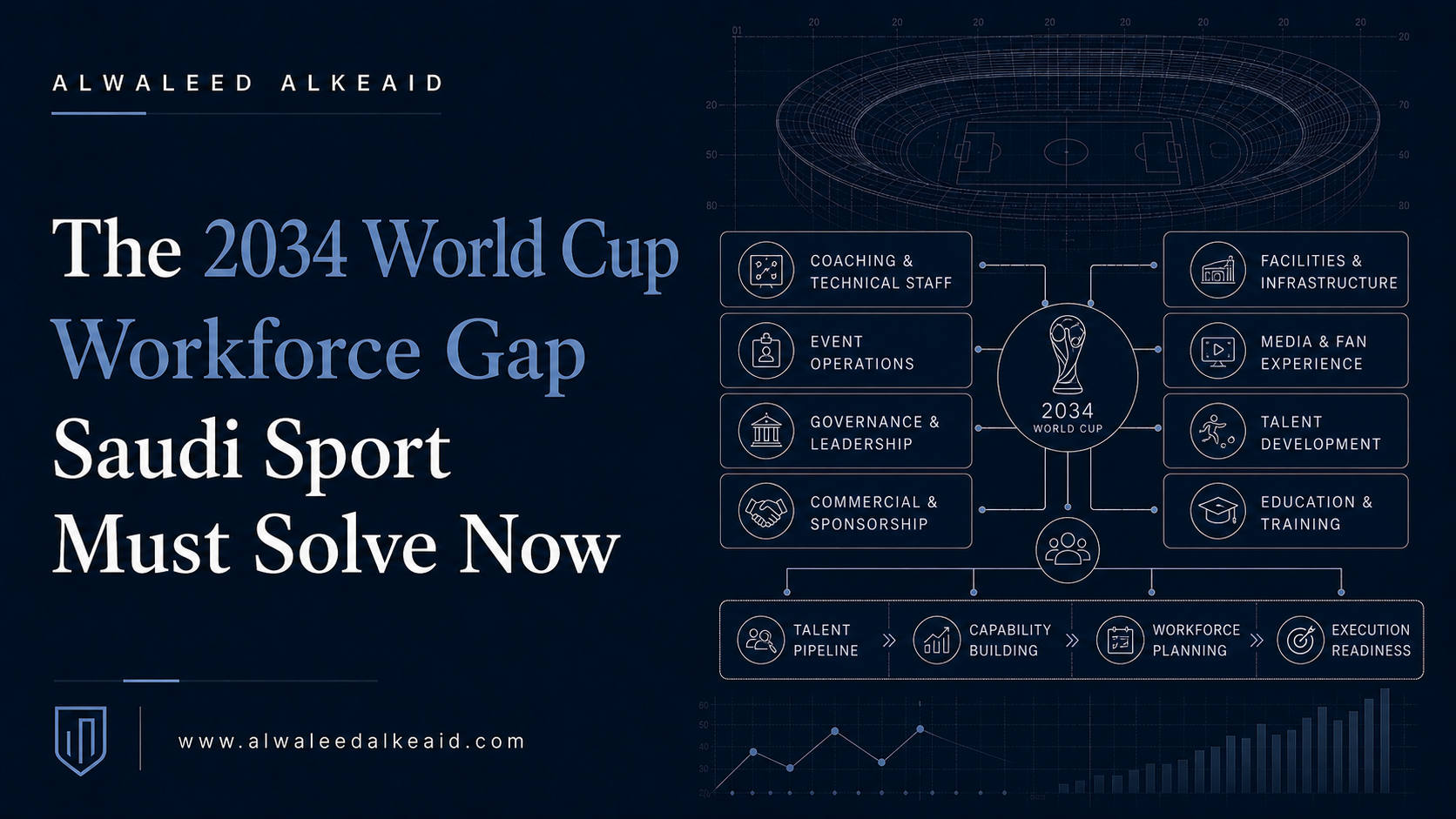
The 2034 World Cup workforce gap may become one of the most important challenges in Saudi sport over the next decade.
Saudi Arabia has already won the right to host the FIFA World Cup 2034. FIFA confirmed the Kingdom as host on December 11, 2024, placing Saudi Arabia at the center of the global football calendar.
That achievement is historic.
Yet hosting the World Cup is not only about stadiums, hotels, airports, fan zones, and broadcast operations. It is also about people.
The tournament will require a deep workforce across football operations, event delivery, venue management, security, hospitality, media, transport, medical services, volunteering, fan experience, technology, protocol, commercial operations, and legacy programs.
This is where the real challenge begins.
Saudi Arabia has ambition, investment, and momentum. The next question is whether Saudi sport can build enough qualified people, systems, and institutional capability before 2034.
From my experience in sports leadership, recruitment, federation work, and advisory, this is one of the biggest issues many sports organizations underestimate.
Infrastructure can be built faster than people.
A venue can be delivered in years. A capable workforce takes longer.
Why the 2034 World Cup workforce gap matters now
Saudi Arabia’s official 2034 bid plans include 15 proposed stadiums across five host cities, with additional host locations mainly available as team base camp sites.
That scale creates a major opportunity.
It also creates pressure.
Every stadium needs trained operators. Each host city needs experienced event teams. Team base camps require football operations specialists. Fan festivals need crowd management, entertainment programming, commercial planning, safety systems, and visitor services.
A World Cup workforce is not one team.
It is an ecosystem.
The tournament will need leaders, managers, coordinators, technical specialists, frontline staff, volunteers, contractors, consultants, and partners who can work under pressure, follow international standards, and deliver consistently across multiple cities.
That cannot be built at the last minute.
If Saudi Arabia waits until 2032 or 2033 to solve the workforce question, the country will have to rely too heavily on imported expertise. International experts will be needed, of course, but the real legacy comes when Saudi professionals gain experience, lead operations, and carry that knowledge into the future of the sports sector.
The 2034 World Cup workforce gap is not only a tournament issue.
It is a national sports capability issue.
Hosting is not the same as building capability
Saudi Arabia has hosted major international sports events across football, motorsport, boxing, esports, golf, tennis, and other areas. The country’s World Cup platform highlights the Kingdom’s experience hosting more than 100 international sports events.
That experience matters.
Major events create operational knowledge, expose local teams to global standards, and build confidence. Still, hosting events does not automatically create a sustainable workforce.
Knowledge can disappear after an event if it is not captured.
External agencies may deliver the work, while local teams remain observers. Volunteers may gain experience once, but then move into unrelated careers. Young professionals may support operations without clear pathways into full-time sports jobs.
This is the gap Saudi sport must close.
A true legacy system should answer clear questions:
Who gained experience?
What skills did they develop?
Where will they work next?
How will knowledge transfer happen?
Which roles should become permanent?
How will clubs and federations benefit after the event?
Without these answers, event experience becomes temporary.
With the right system, every major event before 2034 becomes a training ground.
The roles Saudi sport must develop before 2034
The 2034 World Cup workforce gap will not be solved by hiring only event managers.
Saudi sport needs a much wider talent map.
Football operations will need competition managers, team services staff, training site coordinators, match operations specialists, refereeing support teams, equipment managers, and technical coordinators.
Venue operations will require stadium managers, crowd safety teams, facility managers, access control leads, pitch management teams, cleaning contractors, maintenance staff, and emergency response coordinators.
Fan experience needs guest services managers, volunteer leaders, ticketing teams, fan zone operators, accessibility specialists, digital support teams, hospitality staff, and multilingual service teams.
Commercial delivery will depend on sponsorship managers, partnership activation teams, licensing specialists, merchandise operators, hospitality sales teams, and brand protection staff.
Media and broadcast operations need press officers, mixed zone managers, content producers, broadcast coordinators, photographers, translators, accreditation teams, and digital communications professionals.
Legacy programs require community sport managers, school program leads, women’s football development specialists, coach educators, grassroots coordinators, and data analysts.
This list is not complete, but it shows the point.
The World Cup requires a full sports workforce, not only football experts.
Clubs and federations must be part of the solution
Too much workforce planning happens around events only.
That is a mistake.
Clubs, federations, academies, universities, training providers, and private sports companies should all play a role in solving the 2034 World Cup workforce gap.
Clubs can become development platforms for sports administrators, coaches, analysts, commercial managers, media staff, and fan engagement professionals.
Federations can create technical pathways, event training, governance education, and sport-specific development programs.
Academies can prepare coaches, scouts, performance staff, and youth development specialists.
Universities and institutes can build programs in sports management, event operations, facility management, sports marketing, and high-performance leadership.
Private companies can support practical training through internships, project-based learning, and secondments.
No single organization can build the workforce alone.
Saudi sport needs a connected talent system.
The risk of filling roles too late
When major events approach, organizations often move into urgent hiring mode.
That creates problems.
Roles get filled quickly instead of strategically. Job descriptions become unclear. People are hired for event experience but may not understand local context. Local professionals get placed into support roles instead of leadership pathways.
Urgent hiring can deliver an event.
It rarely builds a sector.
Saudi sport should avoid this pattern.
The workforce plan for 2034 should start with a clear question:
Which roles do we want Saudi professionals to lead by the time the World Cup begins?
That question changes everything.
Instead of only asking who can deliver the tournament, leaders begin asking who can grow through the journey.
This is where sports executive recruitment and workforce planning become strategic priorities, not administrative tasks.
What Saudi sport should build now
The next step is not only more training courses.
Saudi Arabia needs a practical workforce development system.
First, leaders should map the roles required for 2034 and beyond. This includes event roles, club roles, federation roles, commercial roles, technical roles, and venue roles.
Next, the sector needs a skills gap assessment. Which roles already have strong local talent? Where is the shortage most serious? Which roles require international expertise now but Saudi succession later?
A national sports workforce academy could help if it focuses on practical delivery, not theory alone. Training should include simulations, case studies, venue visits, tournament placements, shadowing, and real operational experience.
Clubs and federations should also create structured internship and graduate pathways. Young Saudis need entry points into the industry before 2034, not after.
Professional certification can support quality, but experience matters more.
The best learning will happen inside real sports environments.
Why leadership roles matter most
Saudi Arabia will need thousands of frontline staff and volunteers for 2034.
That is important.
Leadership roles, however, may matter even more.
A tournament can survive inexperienced frontline staff if managers are strong. Weak leadership creates confusion across every layer.
Saudi sport needs more people who can lead departments, manage stakeholders, control budgets, supervise teams, communicate under pressure, solve problems, and make decisions in complex environments.
That includes venue directors, operations directors, competition managers, city leads, volunteer managers, safety leaders, commercial directors, workforce managers, and legacy program heads.
These roles take time to develop.
A leader who can manage a World Cup department in 2034 should start gaining experience now through club operations, federation projects, major events, international secondments, and leadership development programs.
This is also where sports leadership advisory becomes relevant. The challenge is not only finding people. It is preparing them to lead.
2034 must strengthen clubs, not only the tournament
The World Cup can become a turning point for Saudi football.
But only if the benefits reach clubs.
Saudi Arabia’s football ecosystem needs more than tournament delivery. It needs stronger club administrators, better academy staff, improved matchday operations, deeper fan engagement, stronger commercial departments, and more qualified technical leaders.
The 2034 World Cup workforce gap should therefore be linked to club development.
Every professional club should ask:
Which roles do we need to upgrade before 2034?
How can our staff gain event experience?
Can we develop future venue managers, media officers, commercial leads, and operations specialists?
Are our academy and technical staff ready for higher standards?
How do we keep talent after they gain experience?
If clubs do not connect themselves to the World Cup workforce agenda, the tournament may strengthen event delivery without strengthening the domestic football system enough.
That would be a missed opportunity.
Worker welfare and global scrutiny
Every World Cup attracts global attention.
Saudi Arabia’s tournament will be no different.
International media, football bodies, fans, sponsors, and governments will watch not only what is built, but how it is built and delivered.
This means workforce planning must include standards, not only numbers.
Training, contracts, safety, accommodation, working hours, grievance channels, recruitment practices, and supplier oversight will all matter.
A strong workforce system protects the tournament.
More importantly, it protects people.
Saudi Arabia has the opportunity to show that major sports events can create capability, opportunity, and responsible employment standards. That requires planning from the beginning, not late-stage reputation management.
A practical workforce roadmap for Saudi sport
Saudi sport should treat the next eight years as a workforce development cycle.
The first phase should focus on mapping and diagnosis. Leaders need a clear picture of required roles, current talent, missing capabilities, and priority gaps.
A second phase should build training pathways across clubs, federations, universities, and private providers. These pathways should connect classroom learning with real event placements.
From there, the sector should use every major event as a live development platform. Staff should rotate through roles, receive feedback, and build documented experience.
By 2030, Saudi Arabia should have a stronger pool of mid-level managers ready for senior responsibility.
Between 2030 and 2034, the focus should shift to leadership readiness, operational testing, succession planning, and tournament-specific delivery.
The goal is simple.
By the time the World Cup arrives, Saudi professionals should not only participate.
They should lead.
What boards and executives should do next
Sports boards and executives should not wait for national programs to solve everything.
Each organization can start now.
Clubs should review their leadership structure and identify workforce gaps across operations, commercial, academy, media, finance, fan engagement, and technical departments.
Federations need to assess whether their staff, committees, and event teams can support the next decade of growth.
Universities and training providers should speak directly with clubs and federations before designing programs.
Private sports companies can create apprenticeship-style roles that give young professionals real experience.
Government-linked entities and event organizers should require knowledge transfer plans in major event contracts.
Every organization should ask one practical question:
Who are we developing now for the sports industry Saudi Arabia will need in 2034?
That question should shape hiring, training, internships, partnerships, and leadership development.
The workforce is the legacy
The 2034 World Cup will be one of the most important moments in Saudi sports history.
Stadiums will matter. Infrastructure will matter. Fan experience will matter. Global perception will matter.
Yet the deepest legacy may be the people.
If Saudi Arabia uses the next decade to build a stronger sports workforce, the World Cup can leave behind more than memories. It can leave behind leaders, managers, coaches, operators, commercial teams, technical experts, volunteers, and young professionals who will strengthen the sports sector for decades.
That is why the 2034 World Cup workforce gap must be solved now.
The real question is not only whether Saudi Arabia can host the tournament.
The bigger question is whether Saudi sport can use the tournament to build the people and systems needed for long-term performance.
Ambition brought Saudi Arabia to the World Cup.
A capable workforce will decide what the World Cup leaves behind.
If your club, federation, sports organization, or event company is preparing for Saudi Arabia’s next phase of sports growth, the first step is understanding the people and systems required to deliver.
I work with sports leaders and organizations on sports executive recruitment, sports strategy and governance advisory, workforce planning, leadership structures, and execution systems that help ambition become sustainable performance.